Category: History

  • Sierra Leone civil war timeline, 1991–2002

    Sierra Leone civil war timeline, 1991–2002

    In short: the Sierra Leone civil war ran from 23 March 1991, when the Revolutionary United Front crossed from Liberia, to 18 January 2002, when President Ahmad Tejan Kabbah declared it over. It saw two coups, mercenary and regional interventions, the January 1999 attack on Freetown, the Lomé Peace Agreement of July 1999, a UN force of up to 17,500 and British troops in 2000. Estimates of the dead range from 50,000 to 70,000.

    The war in Sierra Leone lasted almost eleven years and touched every district of the country. It is often remembered through diamonds, child soldiers and amputations, but its course was complicated: alliances shifted, governments fell, and several peace deals collapsed before one held. This Sierra Leone civil war timeline sets out the main events in order, with the background needed to follow them. It draws on the sources listed at the end; casualty figures are estimates and vary by source.

    What caused the Sierra Leone civil war?

    Sierra Leone became independent in 1961. After the death of the first prime minister, Sir Milton Margai, in 1964, politics were increasingly marked by corruption, mismanagement and electoral violence, according to the Wikipedia history of the war. Siaka Stevens, in power from 1968, turned the country into a one-party state and handed over to Major General Joseph Momoh in 1985. By 1991 Sierra Leone was one of the poorest countries in the world despite its diamonds, gold, bauxite and rutile.

    Diamonds, found in the early 1930s in Kono and Kenema, slipped out of state control after De Beers withdrew in 1984; by the late 1980s almost all were smuggled. Next door, the First Liberian Civil War sent about 80,000 refugees to the border. The Truth and Reconciliation Commission later concluded that endemic greed, corruption and nepotism were the central cause, and that diamonds, while fought over, did not cause the war.

    Hands sifting wet gravel in a wooden sieve beside a muddy river
    Alluvial diamond areas were fought over throughout the war. Illustration.

    1991–1995: the RUF war and the NPRC

    On 23 March 1991 the Revolutionary United Front (RUF), led by Foday Sankoh and backed by Charles Taylor’s National Patriotic Front of Liberia, crossed into Sierra Leone to overthrow Momoh’s government. Within a year it held large areas of the east and south, including diamond fields.

    On 29 April 1992 junior officers led by Captain Valentine Strasser overthrew Momoh and formed the National Provisional Ruling Council (NPRC). With Nigerian ECOMOG help the army retook Koidu and the Kono diamond districts in March 1993 and pushed the RUF to the Liberian border; many thought the war was over. It was not. In January 1995 the RUF and dissident soldiers seized the bauxite and rutile mines in Moyamba and Bonthe.

    1995–1997: mercenaries, elections and Abidjan

    In March 1995 the government hired Executive Outcomes, a South African private military company, for a reported $1.8 million a month. Its force of 500 advisers and 3,000 soldiers, with air support and working alongside loyal troops and Kamajor militias, drove the RUF back within days and retook the diamond districts within seven months.

    Elections in February and March 1996 brought Ahmad Tejan Kabbah of the Sierra Leone People’s Party to power. On 30 November 1996 the government and RUF signed the Abidjan Peace Accord, the date from which the Special Court would later claim jurisdiction. In January 1997 Kabbah ordered Executive Outcomes out before a neutral monitoring force arrived, and in March 1997 Sankoh was arrested in Nigeria.
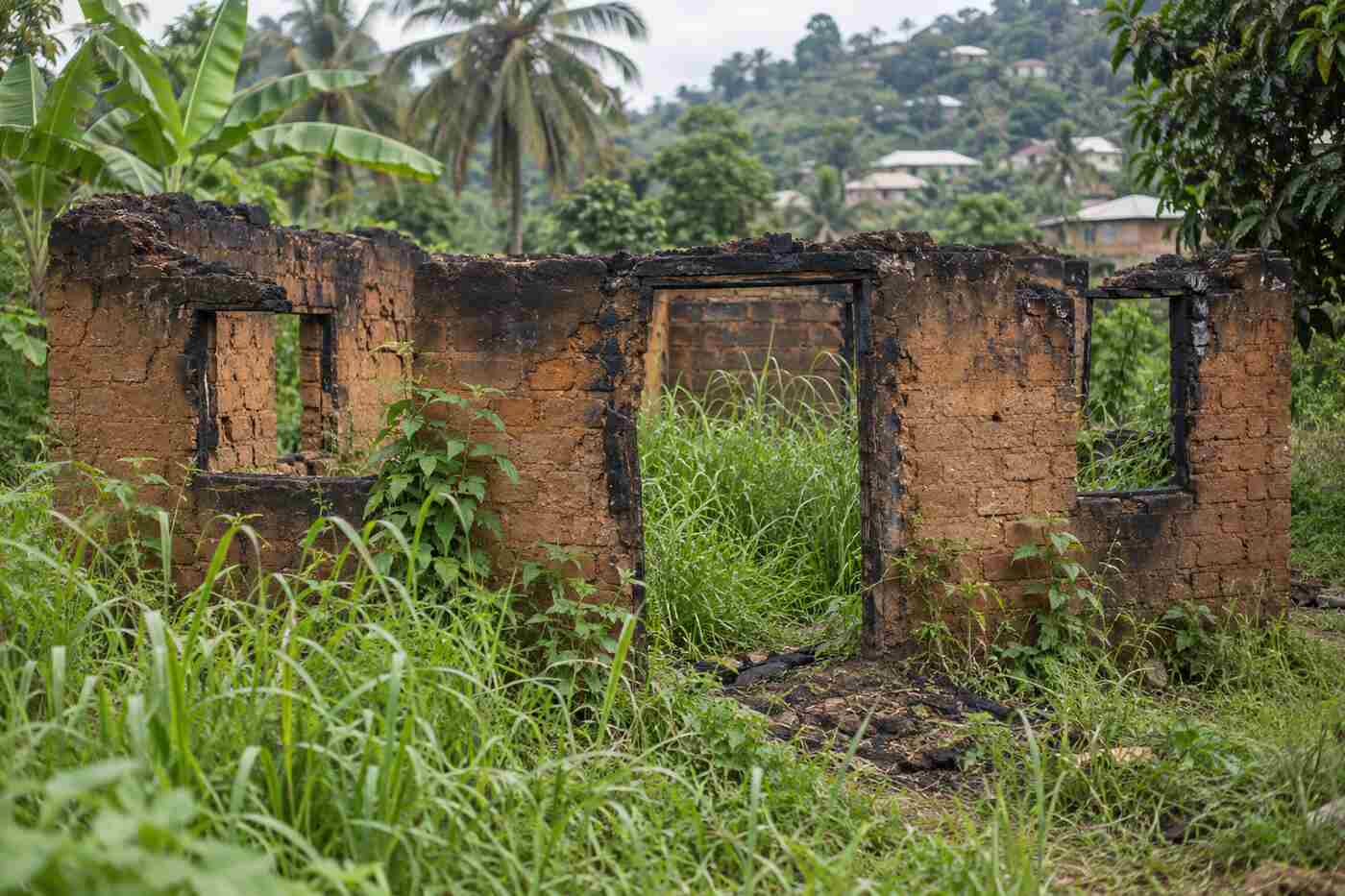
    The roofless shell of a burnt mud-brick house overgrown with grass
    Villages across the east and south were destroyed. Illustration.

    1997–1998: the AFRC coup

    On 25 May 1997 army officers staged a coup, freed and armed 600 prisoners from Pademba Road prison and set up the Armed Forces Revolutionary Council (AFRC) under Major Johnny Paul Koroma. About 5,000 RUF and dissident soldiers took Freetown, and Koroma made the detained Sankoh his deputy. A Conakry peace plan in October 1997 failed. In March 1998 ECOMOG forces retook Freetown and restored Kabbah.

    January 1999: the attack on Freetown

    In January 1999 AFRC and RUF forces attacked the capital. The assault, known as “Operation No Living Thing,” was among the worst episodes of the war. A Human Rights Watch report cited by Wikipedia estimated that more than 7,000 people were killed, at least half of them civilians. The Special Court later found that Charles Taylor helped plan attacks on Kono, Makeni and Freetown in late 1998 and January 1999; see our guide to the Special Court for Sierra Leone.
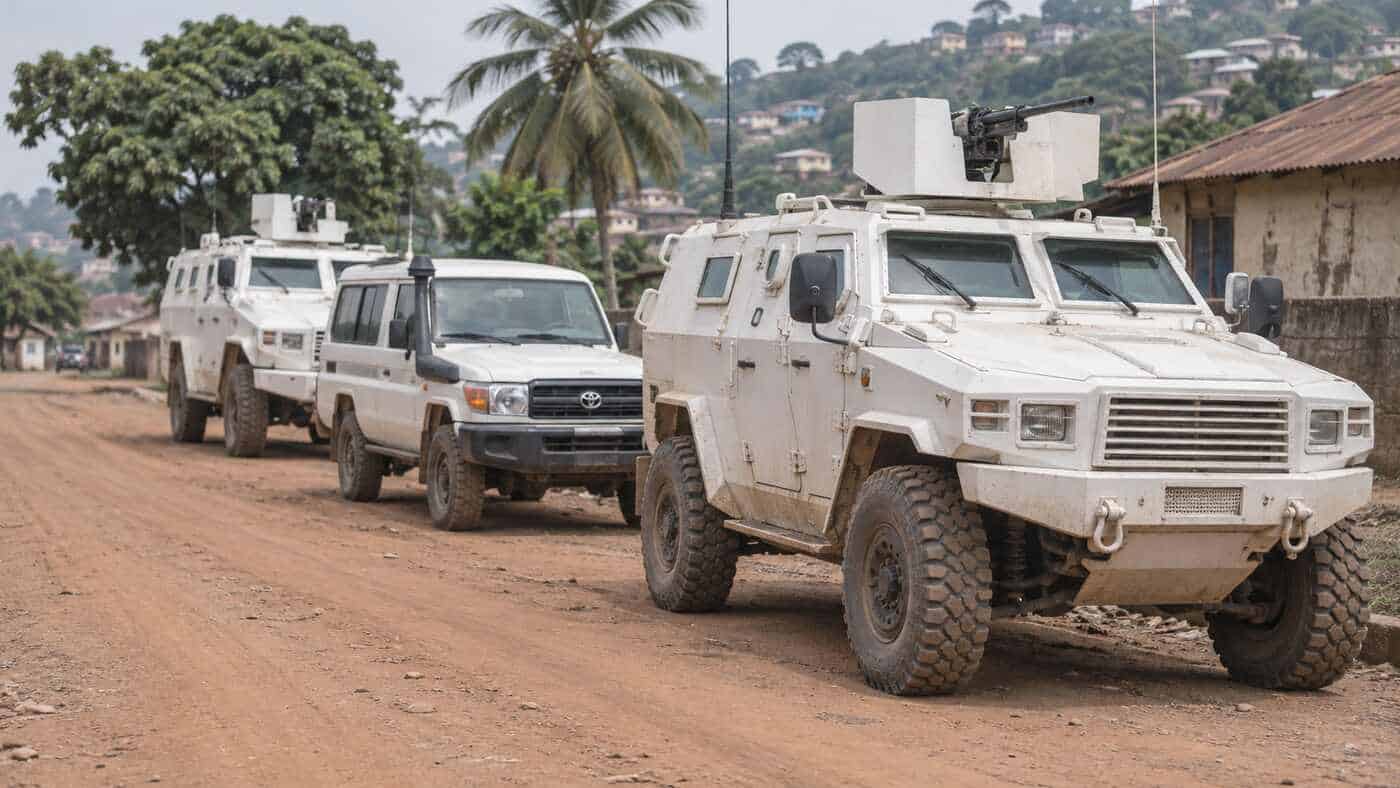
    White peacekeeping vehicles parked in a row on a dusty road, no markings visible
    UNAMSIL became the largest UN force in the world. Illustration.

    July 1999: the Lomé Peace Agreement

    Exhausted and with Nigerian support weakening, Kabbah negotiated. A ceasefire was signed in Lomé, Togo, on 18 May 1999, and the Lomé Peace Agreement on 7 July 1999; Parliament ratified it unanimously on 16 July. Its 37 articles granted amnesty to Sankoh and all combatants, let the RUF become a political party, offered it four cabinet posts and gave Sankoh, with the status of vice-president, the chairmanship of the commission over strategic resources, including diamonds. The UN representative signed with a caveat that the amnesty did not cover war crimes or crimes against humanity. (One section of the Wikipedia war article gives 27 March 1999 for the signing; the Lomé article and the TRC record 7 July.)

    2000–2002: UNAMSIL, British troops and peace

    The UN set up its mission, UNAMSIL, in October 1999, with troops arriving from December. In May 2000 the RUF seized more than 500 peacekeepers and advanced on Freetown. British forces landed in Operation Palliser to evacuate foreigners and stabilise the capital; with half the country still under RUF control, a 1,200-strong British force helped tilt the balance toward the government. Operation Khukri rescued 223 Gurkha Rifles soldiers besieged for more than 75 days at Kailahun.

    UNAMSIL grew to 17,500 troops by March 2001, then the largest UN force in the world. Disarmament began in earnest in May 2001. By 2002 the camps had collected more than 45,000 weapons and processed more than 70,000 former combatants. On 18 January 2002 Kabbah declared the war over.
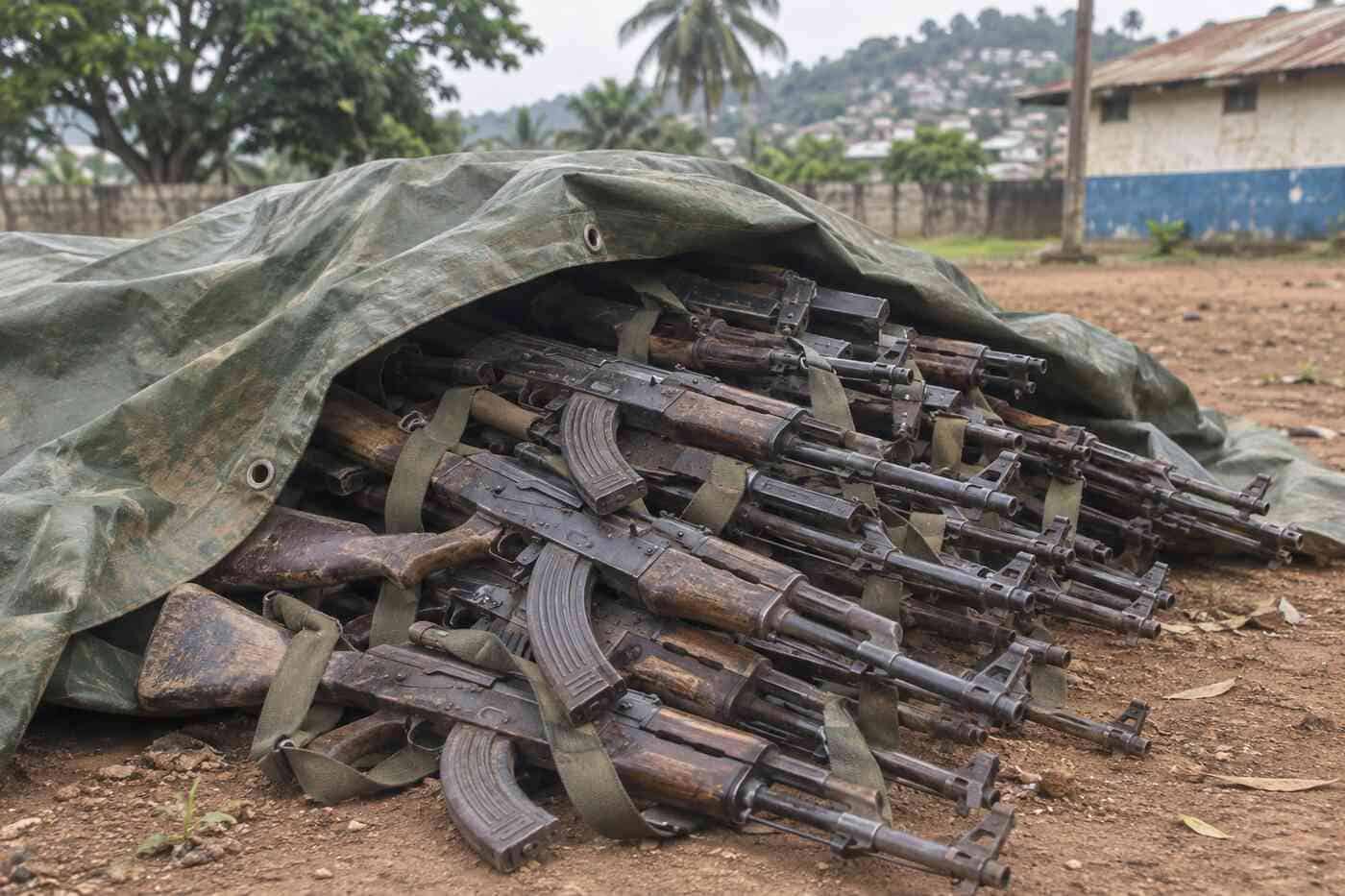
    A pile of decommissioned rifles under a tarpaulin in an open yard
    Disarmament camps collected more than 45,000 weapons. Illustration.

    Sierra Leone civil war timeline at a glance

    DateEvent
    23 Mar 1991RUF invades from Liberia
    29 Apr 1992NPRC coup; Strasser takes power
    Mar 1995Executive Outcomes arrives
    Feb–Mar 1996Elections; Kabbah becomes president
    30 Nov 1996Abidjan Peace Accord
    25 May 1997AFRC coup; Freetown taken
    Mar 1998ECOMOG restores Kabbah
    Jan 1999AFRC/RUF attack on Freetown
    7 Jul 1999Lomé Peace Agreement
    Oct 1999UNAMSIL established
    May 2000Peacekeepers seized; British intervention
    18 Jan 2002War declared over

    The human cost

    Estimates of the dead range from 50,000 to 70,000, and about 2.5 million people were displaced inside and outside the country. The war destroyed 1,270 primary schools. About a quarter of government soldiers were under 18, and the TRC found that children aged 10 to 14 were especially targeted for forced recruitment. A Physicians for Human Rights report attributed 93 per cent of sexual assaults to the RUF and estimated 215,000 to 257,000 victims of rape. The TRC found that both sides deliberately targeted civilians.
    Candles burning on a stone step at dusk beside fresh flowers
    Sierra Leone held its first National Day of Remembrance in 2026. Illustration.

    After the war: justice and remembrance

    Kabbah won re-election in May 2002; the RUF’s party won no seats. The Truth and Reconciliation Commission, chaired by Bishop Joseph Christian Humper, sat from 2002 to 2004 and presented its report on 5 October 2004. The Special Court indicted 23 people. Sankoh died in custody in July 2003 before trial. UNAMSIL left in December 2005. On 18 January 2026 Sierra Leone held its first National Day of Remembrance for the war’s victims. The war also shaped the country’s press; our history of newspapers in Sierra Leone and history of Freetown cover those stories.

    Key takeaways

    • The Sierra Leone civil war lasted from 23 March 1991 to 18 January 2002.
    • The TRC named corruption and failed governance as its central cause, not diamonds alone.
    • Two coups, in 1992 and 1997, and several failed peace deals preceded the 1999 Lomé agreement.
    • UN peacekeepers and British troops in 2000 helped end the fighting.
    • Between 50,000 and 70,000 people died and about 2.5 million were displaced.

    Common questions

    When did the Sierra Leone civil war start and end?

    It started on 23 March 1991, when the RUF crossed from Liberia, and ended on 18 January 2002, when President Kabbah formally declared it over. That is almost eleven years. Disarmament had begun in earnest in May 2001.

    Who were the RUF?

    The Revolutionary United Front, a rebel movement led by Foday Sankoh and backed by Charles Taylor’s forces in Liberia. It fought to overthrow the government and became notorious for attacks on civilians, forced recruitment of children and amputations. Its leaders were later tried by the Special Court.

    How many people died in the Sierra Leone civil war?

    Estimates range from 50,000 to 70,000 dead, with about 2.5 million people displaced. The January 1999 attack on Freetown alone killed more than 7,000, according to a Human Rights Watch estimate. Exact figures are not known.

    Was the war about blood diamonds?

    Diamonds funded armed groups and diamond areas were fought over, but the Truth and Reconciliation Commission concluded that diamonds did not cause the conflict. It named endemic greed, corruption and nepotism, and the collapse of accountable government, as the central causes.

    What ended the war?

    A combination of the 1999 Lomé agreement, a large UN peacekeeping force, British military intervention in 2000 and a disarmament programme that collected more than 45,000 weapons. Kabbah declared the war over on 18 January 2002.

    How we put this together: events and figures follow the Wikipedia history of the civil war, with the peace terms from the Wikipedia article on the Lomé Peace Accord, causes and findings from the TRC article, and court details from the Special Court article. Where these differ, as on the Lomé signing date, we name the difference.

    Sources

  • History of Freetown, Sierra Leone: from 1792 to today

    History of Freetown, Sierra Leone: from 1792 to today

    In short: the history of Freetown, Sierra Leone, begins with a failed 1787 settlement for London’s Black Poor and the founding of Freetown on 11 March 1792 by about 1,100 Black Loyalists from Nova Scotia, who gathered under the Cotton Tree. It became a British Crown Colony in 1808, the capital of British West Africa until 1874, and the capital of independent Sierra Leone in 1961. In 2024 it had about 1.35 million people.

    Freetown is one of the few African capitals founded as a refuge. Its first settlers were people who had escaped or been freed from slavery in Britain, North America and the Caribbean, and later Africans freed from slave ships by the Royal Navy. Their descendants, the Krio, gave the city its language and much of its culture. This guide traces Freetown’s history from the villages that came before it to the modern capital. Sources are listed at the end.

    Before Freetown

    People lived around the Sierra Leone estuary long before Europeans arrived. The earliest known group was the Bullom; the Mane invaded in the 1540s and 1550s and set up chiefdoms, and Temne and Loko villages stood near the future city, according to the Wikipedia history of Freetown. In 1568 the English slave trader John Hawkins helped a Mane king destroy Bonga, a town of about 10,000 people in the area.

    The name of the country is older still. In 1462 the Portuguese navigator Pedro de Sintra named the wooded hills Serra Leôa, “Lion Mountains,” Britannica records. By the 1650s British, French, Dutch and Danish companies traded along the coast, including in enslaved people.

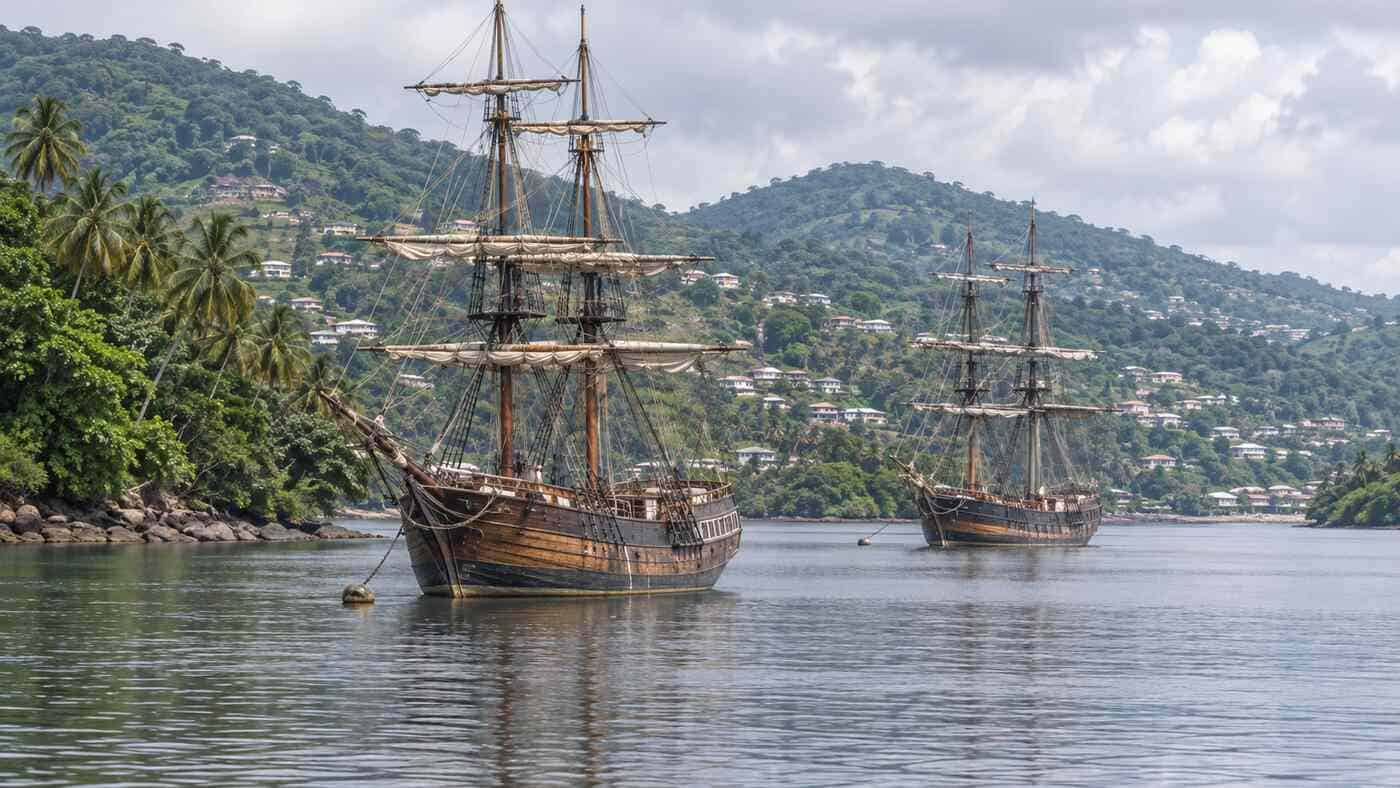
    Tall wooden sailing ships anchored in a wide tropical estuary under hills
    The Nova Scotian settlers arrived in 15 ships in 1792. Illustration.

    The Province of Freedom, 1787

    In 1787 the abolitionist Granville Sharp chose the site south of the river mouth as a haven for the Black Poor, free but destitute Black people in England. About 400 settlers sailed from London under the Committee for the Relief of the Black Poor. They founded the “Province of Freedom” and Granville Town on land bought from the Koya Temne subchief King Tom and the regent Naimbana.

    The settlement struggled. King Tom’s successor, King Jimmy, burned Granville Town in 1789. In 1791 Alexander Falconbridge gathered the survivors and re-established it near what is now Cline Town and Fourah Bay. These “Old Settlers” were later absorbed into the new colony.

    The Nova Scotian founding, 1792

    The city itself was founded by a different group. During the American Revolutionary War, enslaved Africans who fought for Britain were promised freedom; after the war many were evacuated to Nova Scotia, where they received poor land and broken promises. In 1791 one of them, Thomas Peters, went to London to complain. The Sierra Leone Company sent Lieutenant John Clarkson to Nova Scotia to register volunteers.

    More than 1,100 chose to go. They sailed in 15 ships and arrived between 26 February and 9 March 1792; 64 died on the way. On 11 March 1792 they founded Freetown on the site of the first Granville Town, and Clarkson became the colony’s first governor. The town was laid out on an American grid, with Water Street as its main road.

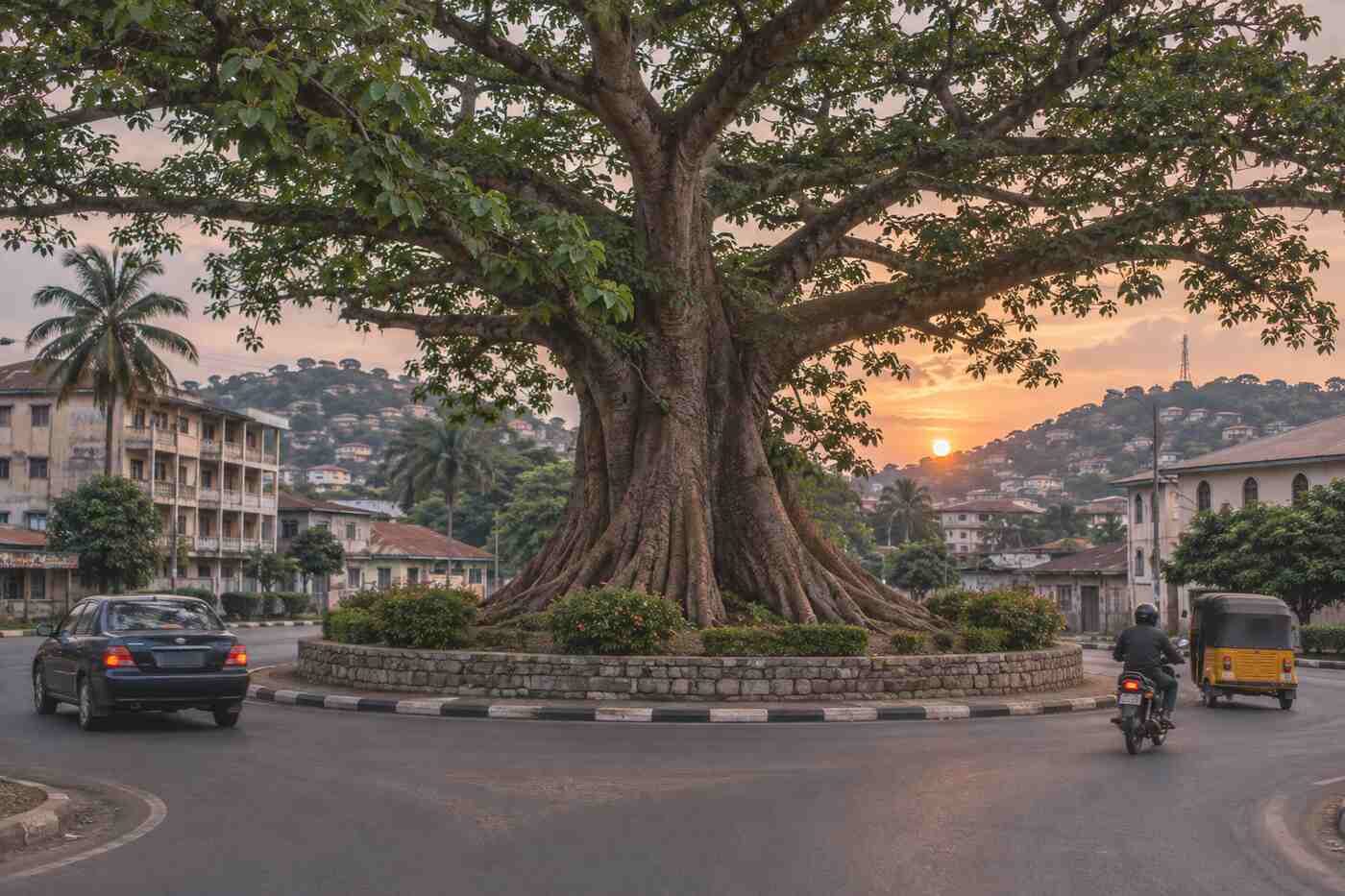
    A huge kapok tree with spreading branches above a city roundabout at dusk
    The Cotton Tree stood at the heart of Freetown until 2023. Illustration.

    Why is the Cotton Tree important?

    According to tradition, the new settlers gathered under a huge kapok tree in March 1792 to pray and give thanks, while Nathaniel Gilbert preached; the Baptist preacher David George held what is described as the first recorded Baptist service in Africa there. The Wikipedia entry on the Cotton Tree notes it was already mature, perhaps 400 years old, and that records of it go back to 1787.

    The tree became the city’s symbol. It appeared on a 1933 stamp and on the first Sierra Leonean banknotes in 1964, and Queen Elizabeth II visited it after independence. It survived fires in 2018 and 2020, but on the night of 24 May 2023 much of it fell in heavy rain. President Julius Maada Bio called it “a physical embodiment of where we come from as a country.” Part of the trunk survived, and remains of the fallen part were taken to a museum.

    Maroons, Liberated Africans and the Krio

    The early colony was turbulent. The French pillaged it in 1794. Nova Scotian settlers complained about land and rule by the company, and in 1800 some rebelled; the authorities put down the revolt with the help of about 550 Jamaican Maroons who had just arrived, and later gave the Maroons their own district, Maroon Town. Temne forces attacked in 1801 and were driven off.

    In 1808 Britain made Freetown a Crown Colony. From then until 1874 it was the capital of British West Africa and the Royal Navy’s base for suppressing the slave trade. Africans freed from captured slave ships were settled there too; Britannica notes that settlers were landed at King Jimmy’s Watering Place, now a market. The Black Poor, Nova Scotians, Maroons and Liberated Africans merged into the Krio, or Creole, people. Krio is still the city’s main language, spoken at home by more than 20 per cent of residents and as a common tongue by most others.

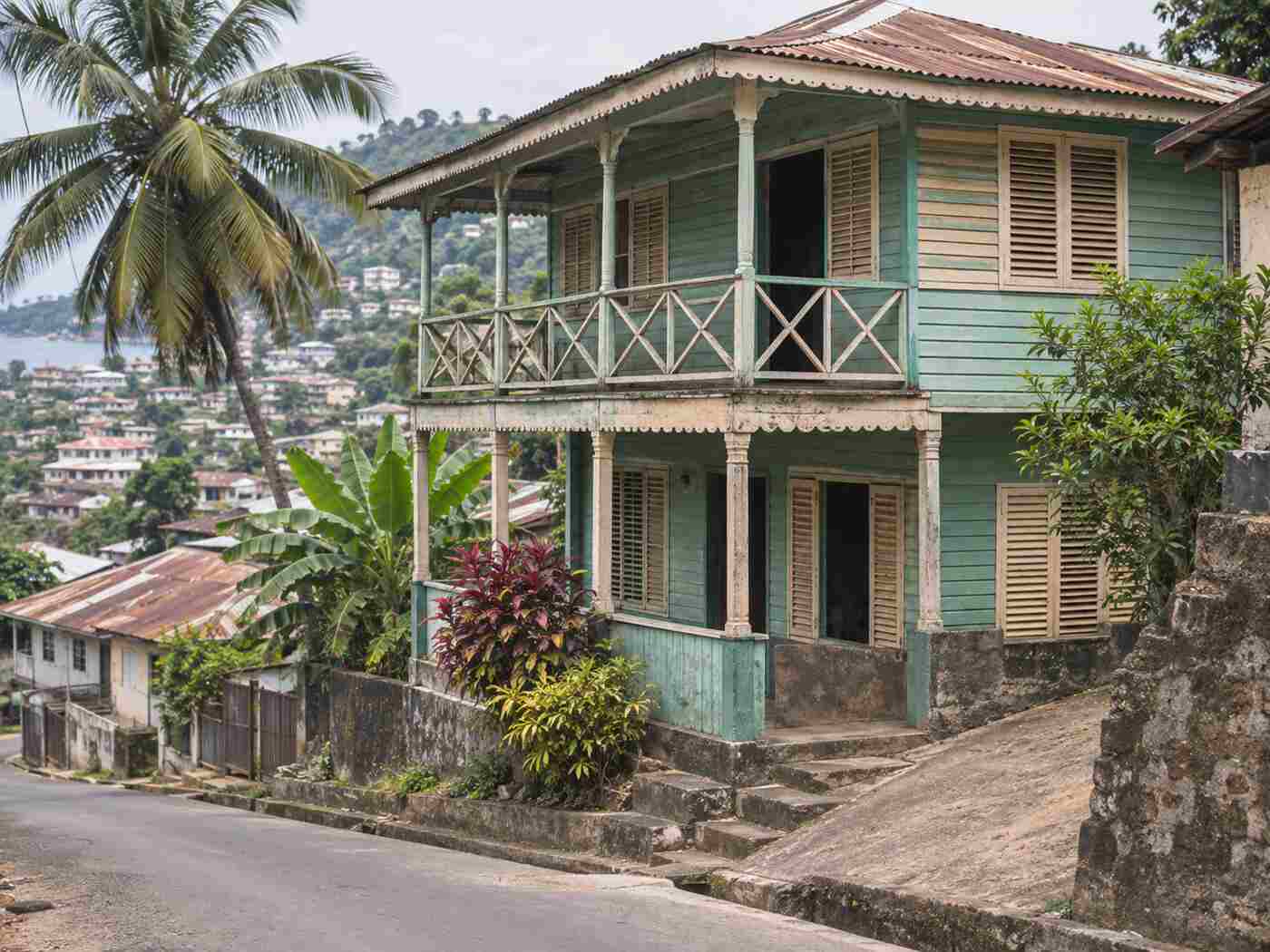
    A two-storey wooden board house with a veranda and shutters on a hillside street
    Krio board houses echo the settlers’ American building styles. Illustration.

    Freetown history timeline

    YearEvent
    1462Pedro de Sintra names the hills Serra Leôa
    1787Black Poor settlers found Granville Town
    1792Nova Scotian settlers found Freetown, 11 March
    1794French raid pillages the town
    1808Freetown becomes a British Crown Colony
    1827Fourah Bay College founded
    1893Incorporated as a municipality
    1961Capital of independent Sierra Leone
    1999January assault on the city during the civil war
    2017Regent mudslide kills more than 300
    2023The Cotton Tree falls, 24 May
    An old stone college building on a green hill overlooking a city
    Fourah Bay College was founded in 1827. Illustration.

    The Athens of West Africa

    Freetown became the education centre of the region. Fourah Bay College, founded in 1827 and now on Mount Aureol, is the oldest university in West Africa and joined the University of Sierra Leone in 1969. Freetown also had one of Africa’s earliest newspaper traditions; our history of newspapers in Sierra Leone covers it.

    Several buildings survive from the colonial city. Fort Thornton, from 1796, is now State House. St George’s Cathedral dates from 1828 according to Wikipedia, while Britannica gives 1852. The National Museum occupied the former Cotton Tree telephone exchange. Freetown was incorporated as a municipality in 1893, and in both world wars its deep natural harbour served as a British naval base and convoy assembly point.

    Independence, war and the modern city

    Freetown became the capital of independent Sierra Leone in 1961. During the civil war it was fought over repeatedly: rebels and mutineers took it in May 1997, ECOMOG forces retook it in 1998, and the AFRC/RUF assault of January 1999 killed thousands. Our Sierra Leone civil war timeline sets out those events, and the Special Court for Sierra Leone sat in the city afterwards.

    The city has grown fast since the war. Its population rose from 772,873 in 2004 to 1,055,964 in 2015 and 1,347,559 in the 2024 census. Disasters have tested it: the Regent mudslide of 14 August 2017 killed more than 300 people, and a fuel tanker explosion on 5 November 2021 killed at least 99. Mayor Yvonne Aki-Sawyerr, elected in 2018 and re-elected in 2022, appointed the city’s first heat officer, Eugenia Kargbo, in 2021.

    Large paper lanterns shaped like boats glowing on a night street, no faces
    The Lantan festival marks the last day of Ramadan. Illustration.

    Freetown culture today

    No ethnic group makes up more than 27 per cent of the city. Krio is the shared language, with Themne second. Christmas street parades run through neighbourhoods for a month, the Tangays festival is usually held at the National Stadium in November, and the Lantan festival on the last day of Ramadan fills streets with lanterns up to 20 feet long. The Leone Stars play at the National Stadium, and most Premier League clubs are Freetown sides, though the recent champions Bo Rangers come from Bo.

    Key takeaways

    • Freetown was founded on 11 March 1792 by more than 1,100 Black Loyalists from Nova Scotia, after a failed 1787 settlement.
    • The Cotton Tree was the city’s symbol from its founding until it fell on 24 May 2023.
    • From 1808 to 1874 Freetown was the capital of British West Africa and a base against the slave trade.
    • Settlers and Liberated Africans became the Krio, whose language is still the city’s common tongue.
    • The city had 1.35 million people in the 2024 census.

    Common questions

    Who founded Freetown?

    Freetown was founded on 11 March 1792 by more than 1,100 Black Loyalists, formerly enslaved Africans who had fought for Britain in the American Revolutionary War and been resettled in Nova Scotia. They were led by Lieutenant John Clarkson of the Sierra Leone Company, who became the first governor.

    Why is it called Freetown?

    The Sierra Leone Company’s directors ordered the settlement to be named “Free Town” in March 1792, because it was founded as a home for people freed from slavery. The earlier 1787 settlement had been called the Province of Freedom.

    What happened to the Cotton Tree in Freetown?

    Much of the Cotton Tree toppled in heavy rain on the night of 24 May 2023. Part of the trunk and a leafy section survived, and a March 2024 report found it still alive. Remains of the fallen part were taken to a museum on the president’s orders.

    Who are the Krio people?

    The descendants of Freetown’s founding groups: the Black Poor from London, the Nova Scotian settlers, Jamaican Maroons and Africans freed from slave ships. Their language, Krio, is the most widely spoken language in Freetown and a common language across Sierra Leone.

    What is the population of Freetown?

    The 2024 census recorded 1,347,559 people in the city and about 1.5 million in the metropolitan area, according to Wikipedia. That is up from 772,873 in 2004.

    How we put this together: the narrative follows the Wikipedia history of Freetown and Britannica’s entry on the city, with the Cotton Tree from its Wikipedia entry. Where they disagree, as on the date of St George’s Cathedral, we give both. War-time events are summarised from our civil war timeline sources.

    Sources

  • Special Court for Sierra Leone: a plain guide, 2002–2013

    Special Court for Sierra Leone: a plain guide, 2002–2013

    In short: the Special Court for Sierra Leone was a hybrid court set up by the United Nations and the Sierra Leone government on 16 January 2002 to try those most responsible for crimes in the civil war after 30 November 1996. It indicted 23 people, convicted leaders of the RUF, AFRC and CDF, and in 2012 convicted Charles Taylor, the first African head of state found guilty of war crimes. It closed on 2 December 2013.

    The Special Court for Sierra Leone sat in Freetown, close to where the crimes it judged had happened. That alone made it different from the tribunals for the former Yugoslavia and Rwanda, which sat far from the victims. It was also a hybrid: it applied both international law and Sierra Leonean law, and its judges and staff included both international and Sierra Leonean members. This guide explains how it was created, who it tried, what it decided and where its records are today. For the war itself, see our Sierra Leone civil war timeline.

    How was the Special Court for Sierra Leone set up?

    On 12 June 2000, President Ahmad Tejan Kabbah wrote to UN Secretary-General Kofi Annan asking the international community to try those responsible for crimes during the conflict, according to the Wikipedia account of the court. On 10 August 2000 the Security Council adopted Resolution 1315, asking the Secretary-General to negotiate a special court with the government.

    The agreement was signed on 16 January 2002, the same week the war was declared over. The first staff arrived in Freetown in July 2002, Sierra Construction Systems built the courthouse, and the new building opened on 10 March 2004. More than 40 states contributed funds by April 2012, with Nigeria the most notable African contributor, and the UN added subvention funding in 2004, 2011 and 2012.

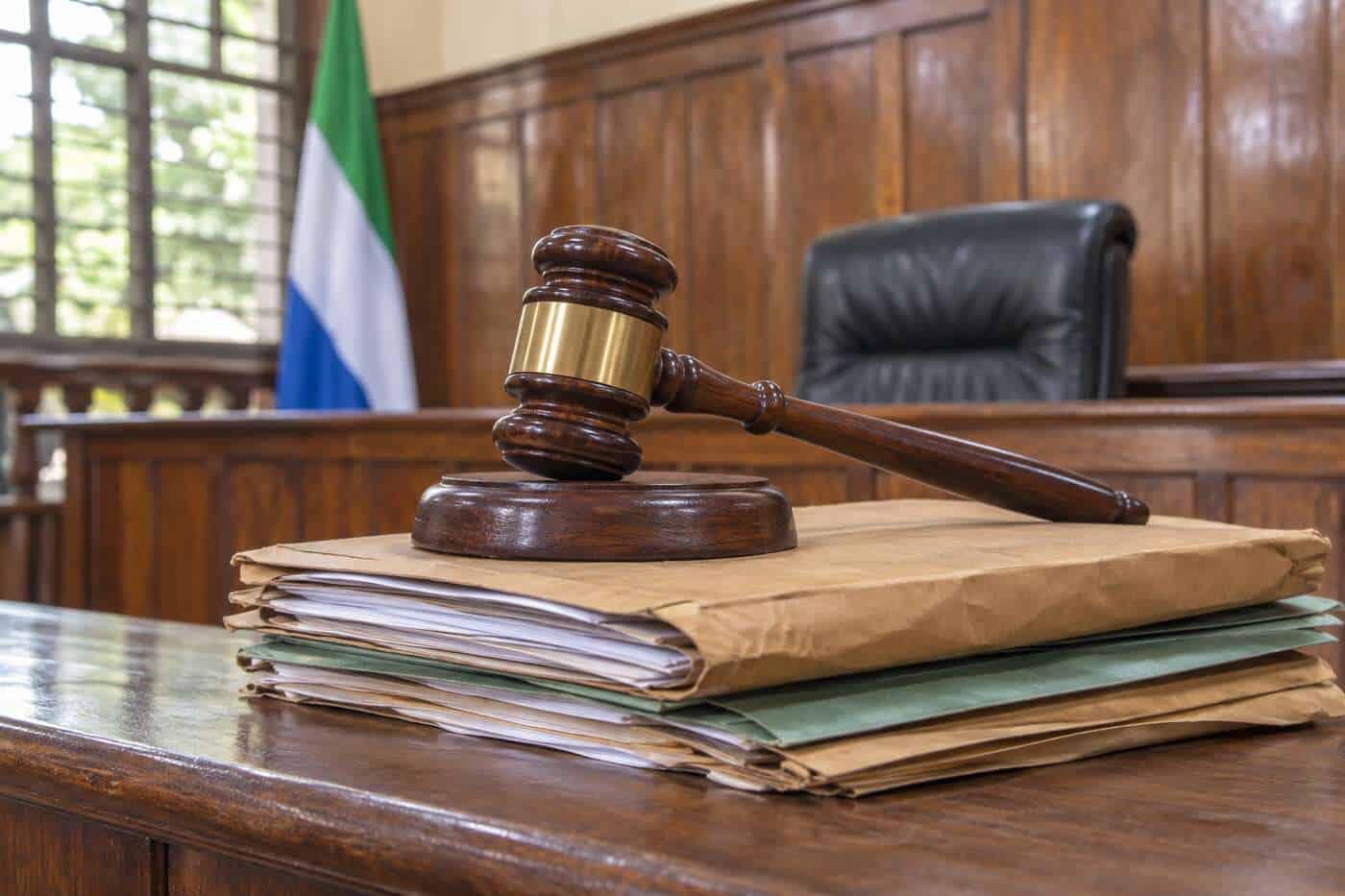
    A judge's gavel resting on stacked legal files in a wood-panelled courtroom
    The court applied international and Sierra Leonean law. Illustration.

    What the court could try

    The court’s jurisdiction ran from 30 November 1996, the date of the Abidjan Peace Accord. It could prosecute crimes against humanity, war crimes, other serious violations of international humanitarian law and certain crimes under Sierra Leonean law, although in the end nobody was charged under domestic law. It had no jurisdiction over anyone under 15.

    Two rules mattered a great deal. The court took priority over Sierra Leone’s own courts where jurisdiction conflicted, and earlier amnesties did not protect anyone from its charges. That second rule set aside, for these crimes, the blanket amnesty in the 1999 Lomé Peace Agreement, which the UN had signed only with a caveat excluding war crimes and crimes against humanity.

    How the court was organised

    The court had three organs: the Chambers, which heard trials and appeals; the Office of the Prosecutor; and the Registry, which ran the court. Its statute allowed eight to eleven judges; at closure it had twelve, seven trial and five appeals judges, with a mix of UN-appointed and Sierra Leone-nominated members serving three-year terms.

    Sierra Leoneans held senior posts. Joseph Kamara, nominated by the government, became deputy prosecutor on 15 August 2008. Binta Mansaray of Sierra Leone was the last registrar, appointed in February 2010 after acting from June 2009. Brenda Hollis, previously the principal trial attorney in the Taylor case, became prosecutor in February 2010.

    An empty witness room with a single chair and a microphone behind a glass screen
    Witness protection was central to the court’s work. Illustration.

    The RUF, AFRC and CDF trials

    The court grouped its main cases by armed faction.

    AFRC. Alex Tamba Brima, Brima Bazzy Kamara and Santigie Borbor Kanu of the Armed Forces Revolutionary Council went on trial on 7 March 2005. On 20 June 2007 each was convicted on 11 of 14 counts, including terrorism, extermination, murder, rape, recruiting child soldiers, enslavement and pillage. These were the court’s first judgments and the first time an international court ruled on charges of conscripting children. Brima and Kanu were sentenced to 50 years and Kamara to 45; the appeal was rejected on 22 February 2008.

    CDF. The trial of Civil Defence Forces leaders Samuel Hinga Norman, Moinina Fofana and Allieu Kondewa began on 3 June 2004. Norman died on 22 February 2007, before judgment. Fofana and Kondewa were convicted in August 2007, and on appeal in 2008 their sentences were raised to 15 and 20 years.

    RUF. Five Revolutionary United Front leaders were indicted. Foday Sankoh and Sam Bockarie died in 2003 and their cases ended. Issa Sesay, Morris Kallon and Augustine Gbao were convicted on 25 February 2009, including of forced marriage, the first such convictions by an international criminal court. Sesay received 52 years, Kallon 40 and Gbao 25. The appeal was rejected on 26 October 2009.

    A modern glass court building on a grey northern European day
    Charles Taylor’s trial was moved to The Hague. Illustration.

    The Charles Taylor case

    The court’s best-known defendant was Charles Taylor, the former president of Liberia, indicted on 7 March 2003. He took asylum in Nigeria, fled in March 2006 and was arrested at the Cameroon border. Because he retained support in Liberia, his trial was moved to The Hague under Security Council Resolution 1688 of 17 June 2006, though it remained a Special Court case.

    The trial opened on 4 June 2007. On 26 April 2012 the Trial Chamber found him guilty on all 11 counts of aiding and abetting, and of planning attacks on Kono, Makeni and Freetown in late 1998 and January 1999, according to the court’s 2012 press release. He was sentenced to 50 years on 30 May 2012. The Appeals Chamber upheld conviction and sentence on 26 September 2013, as recorded in the appeal judgment release, and he was transferred to the United Kingdom to serve it in October 2013.

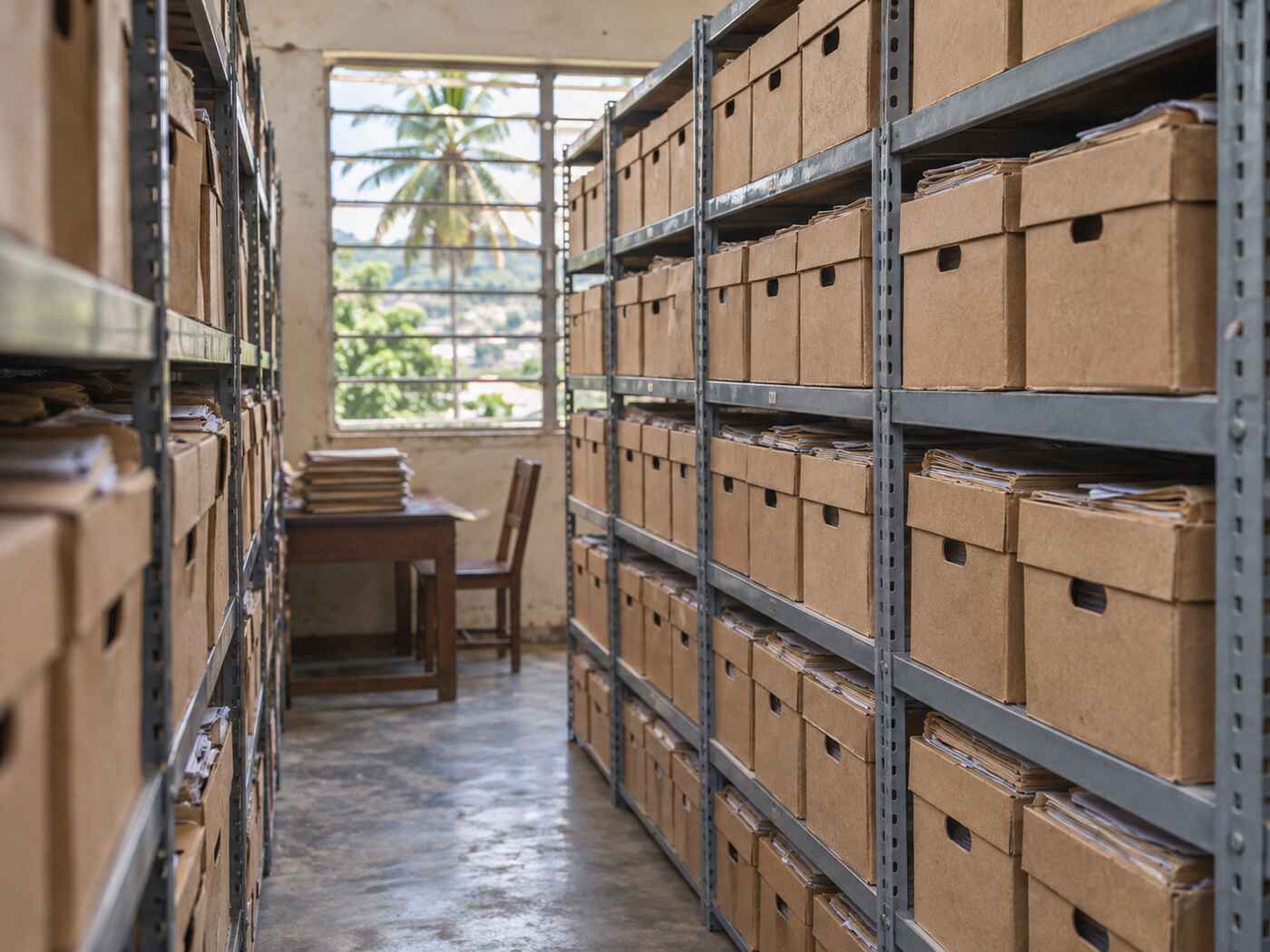
    Rows of archive boxes on metal shelving in a quiet records room
    The Residual Special Court keeps the archives. Illustration.

    Special Court timeline

    DateEvent
    12 Jun 2000President Kabbah asks the UN for a court
    10 Aug 2000Security Council Resolution 1315
    16 Jan 2002Agreement establishing the court signed
    7 Mar 2003First indictments, including Charles Taylor
    10 Mar 2004Freetown courthouse opens
    20 Jun 2007First judgments, in the AFRC case
    25 Feb 2009RUF leaders convicted
    26 Apr 2012Charles Taylor convicted
    26 Sep 2013Taylor appeal judgment
    2 Dec 2013Court closes; Residual Special Court takes over

    What the court changed in international law

    Three firsts stand out. The AFRC judgment was the first guilty verdict by an international court for the military conscription of children. The RUF judgment produced the first international convictions for forced marriage as a crime against humanity. And Taylor became the first African head of state convicted for his part in war crimes; Brenda Hollis said the judgment showed that heads of state would be held accountable.

    The court also prosecuted interference with its own work. Contempt cases in 2005 and 2011–12 dealt with witness intimidation and bribery, and some convicted defendants had years added to their sentences as a result.

    A small memorial garden with stones and young trees under a tropical sky
    The court’s legacy includes its Freetown site. Illustration.

    The Residual Special Court today

    When the court closed on 2 December 2013, the Residual Special Court for Sierra Leone took over. It supervises sentences, protects and supports witnesses, handles compensation claims and requests for information, and keeps the archives. Its website, rscsl.org, holds judgments and press releases for researchers.

    Of the 23 people indicted, the Wikipedia account records that proceedings against 22 are complete. Alex Brima died in 2016 while serving his sentence; Sesay and Kallon were serving theirs in Rwanda; Gbao was granted conditional early release in December 2020. The case of Johnny Paul Koroma, the AFRC chairman, was never closed, because no definitive evidence of his death was provided. The parallel Truth and Reconciliation Commission worked from 2002 to 2004 on the wider record of the war.

    Key takeaways

    • The Special Court for Sierra Leone was a hybrid UN and Sierra Leone court, created on 16 January 2002 and closed on 2 December 2013.
    • It tried leaders of all three main armed factions, the RUF, AFRC and CDF, for crimes after 30 November 1996.
    • Charles Taylor was convicted in 2012 and sentenced to 50 years, upheld on appeal in 2013.
    • Its judgments were the first international convictions for child conscription and forced marriage.
    • The Residual Special Court now manages sentences, witnesses and the archives.

    Common questions

    Why was the Special Court for Sierra Leone called a hybrid court?

    Because it combined international and national elements. It was created by an agreement between the UN and the Sierra Leone government, could apply both international and Sierra Leonean law, and had both UN-appointed and Sierra Leone-nominated judges, as well as Sierra Leonean senior staff such as the deputy prosecutor and the last registrar.

    How many people did the Special Court indict?

    Twenty-three in total. Proceedings against 22 were completed: some were convicted and served or are serving sentences, three were acquitted and three died before their cases ended. The indictment of AFRC chairman Johnny Paul Koroma remained open because his death was never confirmed.

    Why was Charles Taylor tried in The Hague?

    Liberia’s president, Ellen Johnson-Sirleaf, asked for the trial to be moved because Taylor still had considerable support in the region. Security Council Resolution 1688 of June 2006 authorised the move. The trial stayed a Special Court case but used International Criminal Court facilities.

    Did the Lomé amnesty protect war crimes suspects?

    No, not before this court. Its statute said prior amnesties could not bar prosecution for the crimes it covered, and the UN had signed the 1999 Lomé agreement with a caveat that the amnesty did not apply to war crimes or crimes against humanity.

    How we put this together: the structure, cases and dates come from the Wikipedia account of the court, checked against the court’s own 2012 and 2013 press releases for the Taylor judgments; background on the war and the truth commission comes from the linked Wikipedia articles. Sentences are as recorded in those sources.

    Sources