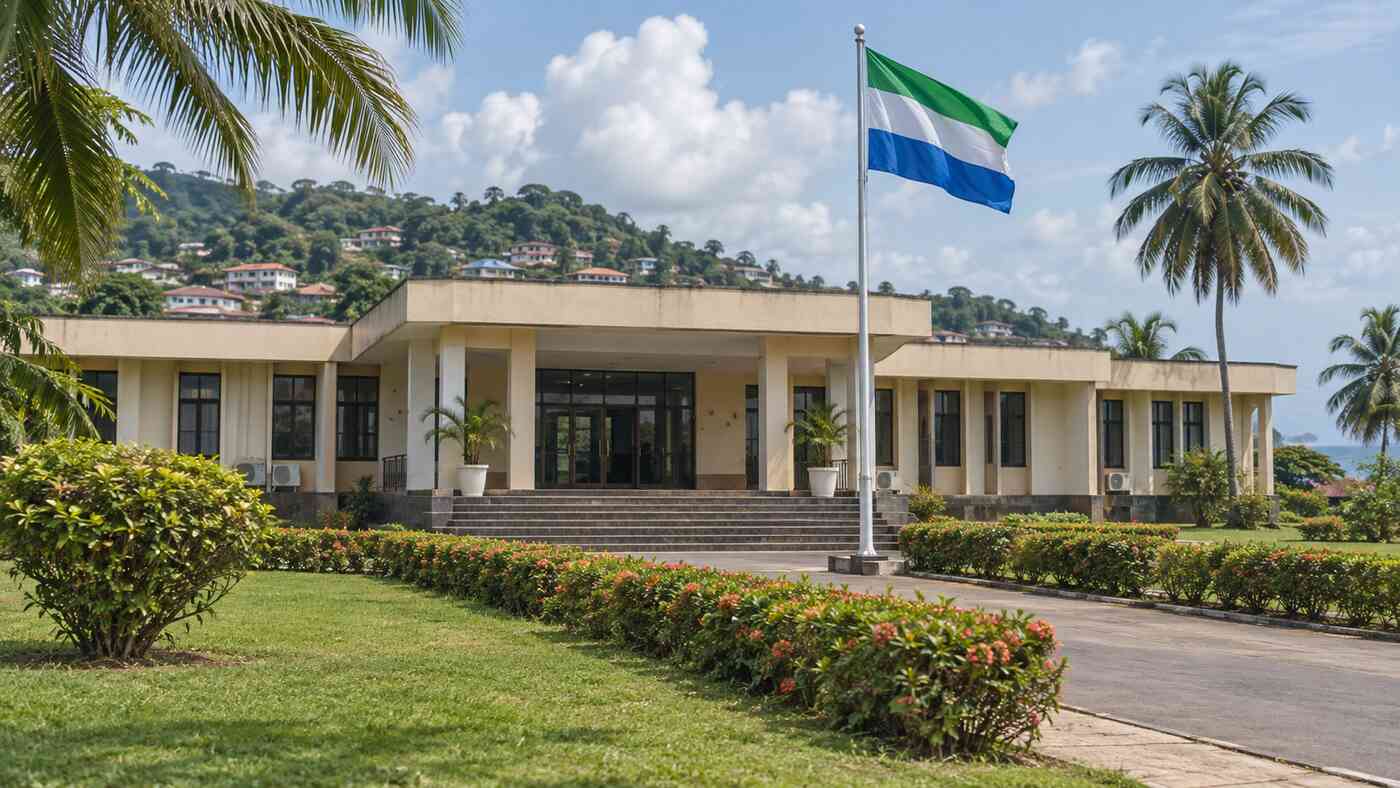
In short: the Special Court for Sierra Leone was a hybrid court set up by the United Nations and the Sierra Leone government on 16 January 2002 to try those most responsible for crimes in the civil war after 30 November 1996. It indicted 23 people, convicted leaders of the RUF, AFRC and CDF, and in 2012 convicted Charles Taylor, the first African head of state found guilty of war crimes. It closed on 2 December 2013.
The Special Court for Sierra Leone sat in Freetown, close to where the crimes it judged had happened. That alone made it different from the tribunals for the former Yugoslavia and Rwanda, which sat far from the victims. It was also a hybrid: it applied both international law and Sierra Leonean law, and its judges and staff included both international and Sierra Leonean members. This guide explains how it was created, who it tried, what it decided and where its records are today. For the war itself, see our Sierra Leone civil war timeline.
How was the Special Court for Sierra Leone set up?
On 12 June 2000, President Ahmad Tejan Kabbah wrote to UN Secretary-General Kofi Annan asking the international community to try those responsible for crimes during the conflict, according to the Wikipedia account of the court. On 10 August 2000 the Security Council adopted Resolution 1315, asking the Secretary-General to negotiate a special court with the government.
The agreement was signed on 16 January 2002, the same week the war was declared over. The first staff arrived in Freetown in July 2002, Sierra Construction Systems built the courthouse, and the new building opened on 10 March 2004. More than 40 states contributed funds by April 2012, with Nigeria the most notable African contributor, and the UN added subvention funding in 2004, 2011 and 2012.
What the court could try
The court’s jurisdiction ran from 30 November 1996, the date of the Abidjan Peace Accord. It could prosecute crimes against humanity, war crimes, other serious violations of international humanitarian law and certain crimes under Sierra Leonean law, although in the end nobody was charged under domestic law. It had no jurisdiction over anyone under 15.
Two rules mattered a great deal. The court took priority over Sierra Leone’s own courts where jurisdiction conflicted, and earlier amnesties did not protect anyone from its charges. That second rule set aside, for these crimes, the blanket amnesty in the 1999 Lomé Peace Agreement, which the UN had signed only with a caveat excluding war crimes and crimes against humanity.
How the court was organised
The court had three organs: the Chambers, which heard trials and appeals; the Office of the Prosecutor; and the Registry, which ran the court. Its statute allowed eight to eleven judges; at closure it had twelve, seven trial and five appeals judges, with a mix of UN-appointed and Sierra Leone-nominated members serving three-year terms.
Sierra Leoneans held senior posts. Joseph Kamara, nominated by the government, became deputy prosecutor on 15 August 2008. Binta Mansaray of Sierra Leone was the last registrar, appointed in February 2010 after acting from June 2009. Brenda Hollis, previously the principal trial attorney in the Taylor case, became prosecutor in February 2010.

The RUF, AFRC and CDF trials
The court grouped its main cases by armed faction.
AFRC. Alex Tamba Brima, Brima Bazzy Kamara and Santigie Borbor Kanu of the Armed Forces Revolutionary Council went on trial on 7 March 2005. On 20 June 2007 each was convicted on 11 of 14 counts, including terrorism, extermination, murder, rape, recruiting child soldiers, enslavement and pillage. These were the court’s first judgments and the first time an international court ruled on charges of conscripting children. Brima and Kanu were sentenced to 50 years and Kamara to 45; the appeal was rejected on 22 February 2008.
CDF. The trial of Civil Defence Forces leaders Samuel Hinga Norman, Moinina Fofana and Allieu Kondewa began on 3 June 2004. Norman died on 22 February 2007, before judgment. Fofana and Kondewa were convicted in August 2007, and on appeal in 2008 their sentences were raised to 15 and 20 years.
RUF. Five Revolutionary United Front leaders were indicted. Foday Sankoh and Sam Bockarie died in 2003 and their cases ended. Issa Sesay, Morris Kallon and Augustine Gbao were convicted on 25 February 2009, including of forced marriage, the first such convictions by an international criminal court. Sesay received 52 years, Kallon 40 and Gbao 25. The appeal was rejected on 26 October 2009.

The Charles Taylor case
The court’s best-known defendant was Charles Taylor, the former president of Liberia, indicted on 7 March 2003. He took asylum in Nigeria, fled in March 2006 and was arrested at the Cameroon border. Because he retained support in Liberia, his trial was moved to The Hague under Security Council Resolution 1688 of 17 June 2006, though it remained a Special Court case.
The trial opened on 4 June 2007. On 26 April 2012 the Trial Chamber found him guilty on all 11 counts of aiding and abetting, and of planning attacks on Kono, Makeni and Freetown in late 1998 and January 1999, according to the court’s 2012 press release. He was sentenced to 50 years on 30 May 2012. The Appeals Chamber upheld conviction and sentence on 26 September 2013, as recorded in the appeal judgment release, and he was transferred to the United Kingdom to serve it in October 2013.
Special Court timeline
| Date | Event |
|---|---|
| 12 Jun 2000 | President Kabbah asks the UN for a court |
| 10 Aug 2000 | Security Council Resolution 1315 |
| 16 Jan 2002 | Agreement establishing the court signed |
| 7 Mar 2003 | First indictments, including Charles Taylor |
| 10 Mar 2004 | Freetown courthouse opens |
| 20 Jun 2007 | First judgments, in the AFRC case |
| 25 Feb 2009 | RUF leaders convicted |
| 26 Apr 2012 | Charles Taylor convicted |
| 26 Sep 2013 | Taylor appeal judgment |
| 2 Dec 2013 | Court closes; Residual Special Court takes over |
What the court changed in international law
Three firsts stand out. The AFRC judgment was the first guilty verdict by an international court for the military conscription of children. The RUF judgment produced the first international convictions for forced marriage as a crime against humanity. And Taylor became the first African head of state convicted for his part in war crimes; Brenda Hollis said the judgment showed that heads of state would be held accountable.
The court also prosecuted interference with its own work. Contempt cases in 2005 and 2011–12 dealt with witness intimidation and bribery, and some convicted defendants had years added to their sentences as a result.

The Residual Special Court today
When the court closed on 2 December 2013, the Residual Special Court for Sierra Leone took over. It supervises sentences, protects and supports witnesses, handles compensation claims and requests for information, and keeps the archives. Its website, rscsl.org, holds judgments and press releases for researchers.
Of the 23 people indicted, the Wikipedia account records that proceedings against 22 are complete. Alex Brima died in 2016 while serving his sentence; Sesay and Kallon were serving theirs in Rwanda; Gbao was granted conditional early release in December 2020. The case of Johnny Paul Koroma, the AFRC chairman, was never closed, because no definitive evidence of his death was provided. The parallel Truth and Reconciliation Commission worked from 2002 to 2004 on the wider record of the war.
Key takeaways
- The Special Court for Sierra Leone was a hybrid UN and Sierra Leone court, created on 16 January 2002 and closed on 2 December 2013.
- It tried leaders of all three main armed factions, the RUF, AFRC and CDF, for crimes after 30 November 1996.
- Charles Taylor was convicted in 2012 and sentenced to 50 years, upheld on appeal in 2013.
- Its judgments were the first international convictions for child conscription and forced marriage.
- The Residual Special Court now manages sentences, witnesses and the archives.
Common questions
Why was the Special Court for Sierra Leone called a hybrid court?
Because it combined international and national elements. It was created by an agreement between the UN and the Sierra Leone government, could apply both international and Sierra Leonean law, and had both UN-appointed and Sierra Leone-nominated judges, as well as Sierra Leonean senior staff such as the deputy prosecutor and the last registrar.
How many people did the Special Court indict?
Twenty-three in total. Proceedings against 22 were completed: some were convicted and served or are serving sentences, three were acquitted and three died before their cases ended. The indictment of AFRC chairman Johnny Paul Koroma remained open because his death was never confirmed.
Why was Charles Taylor tried in The Hague?
Liberia’s president, Ellen Johnson-Sirleaf, asked for the trial to be moved because Taylor still had considerable support in the region. Security Council Resolution 1688 of June 2006 authorised the move. The trial stayed a Special Court case but used International Criminal Court facilities.
Did the Lomé amnesty protect war crimes suspects?
No, not before this court. Its statute said prior amnesties could not bar prosecution for the crimes it covered, and the UN had signed the 1999 Lomé agreement with a caveat that the amnesty did not apply to war crimes or crimes against humanity.
How we put this together: the structure, cases and dates come from the Wikipedia account of the court, checked against the court’s own 2012 and 2013 press releases for the Taylor judgments; background on the war and the truth commission comes from the linked Wikipedia articles. Sentences are as recorded in those sources.
Sources
- Wikipedia: Special Court for Sierra Leone
- Special Court press release: Taylor judgment, 26 April 2012
- Special Court press release: Taylor appeal judgment, 26 September 2013
- Residual Special Court for Sierra Leone
- Wikipedia: Lomé Peace Accord
- Wikipedia: Truth and Reconciliation Commission (Sierra Leone)