Category: Media and law

  • Sierra Leone criminal libel law: the 2020 repeal explained

    Sierra Leone criminal libel law: the 2020 repeal explained

    In short: Sierra Leone’s criminal libel law was Part V of the Public Order Act 1965, which made defamatory and seditious libel crimes punishable by prison. Parliament repealed it in July 2020 through the Public Order (Amendment) Act 2020, and the change was formally celebrated at State House in October 2020. Journalists can no longer be prosecuted for criminal libel, but civil defamation claims and media regulation by the Independent Media Commission still apply.

    For 55 years, a Sierra Leonean journalist could be jailed for publishing something true. That was the effect of the country’s criminal libel law, as editors who lived under it described it. The law was used by governments of different parties, and its repeal in 2020 was the result of a campaign that ran for decades. This guide explains what the law said, how it was used, how it was repealed, and what rules apply to the press now. It is not legal advice. Sources are listed at the end.

    What was Sierra Leone’s criminal libel law?

    The law sat in Part V of the Public Order Act, 1965 (Act No. 46 of 1965), headed “Defamatory and Seditious Libel.” It created criminal offences for publishing defamatory statements and for seditious libel, broadly, publications held to stir up hatred or contempt of the government. Because these were crimes, not civil wrongs, the state could arrest, prosecute and imprison journalists, rather than leaving an offended person to sue for damages.

    The law was passed four years after independence, as our history of newspapers in Sierra Leone describes. It outlived the one-party state, the civil war and several changes of government.

    A row of old bound law books on a shelf with a brass desk lamp
    Part V of the 1965 Public Order Act made libel a crime. Illustration.

    How the law worked in practice

    Kelvin Lewis, editor of Awoko and then president of the Sierra Leone Association of Journalists (SLAJ), explained the law’s effect in a 2016 interview with View from Salone. In his account:

    • Truth could be inquired into, but it was not a defence. A journalist could be jailed even if the story was accurate.
    • Journalists who criticised officials could be arrested and spend days in jail.
    • Owners, printers and even newspaper vendors could be held responsible and jailed for what a reporter wrote.
    • That risk discouraged people with money from investing in the press, which kept media houses poor and pay low.
    • The law “cowered” journalists into limiting what they reported, and hung over them “like a sword of Damocles.”

    Lewis said some people left journalism because of it, and that Awoko kept publishing regardless.
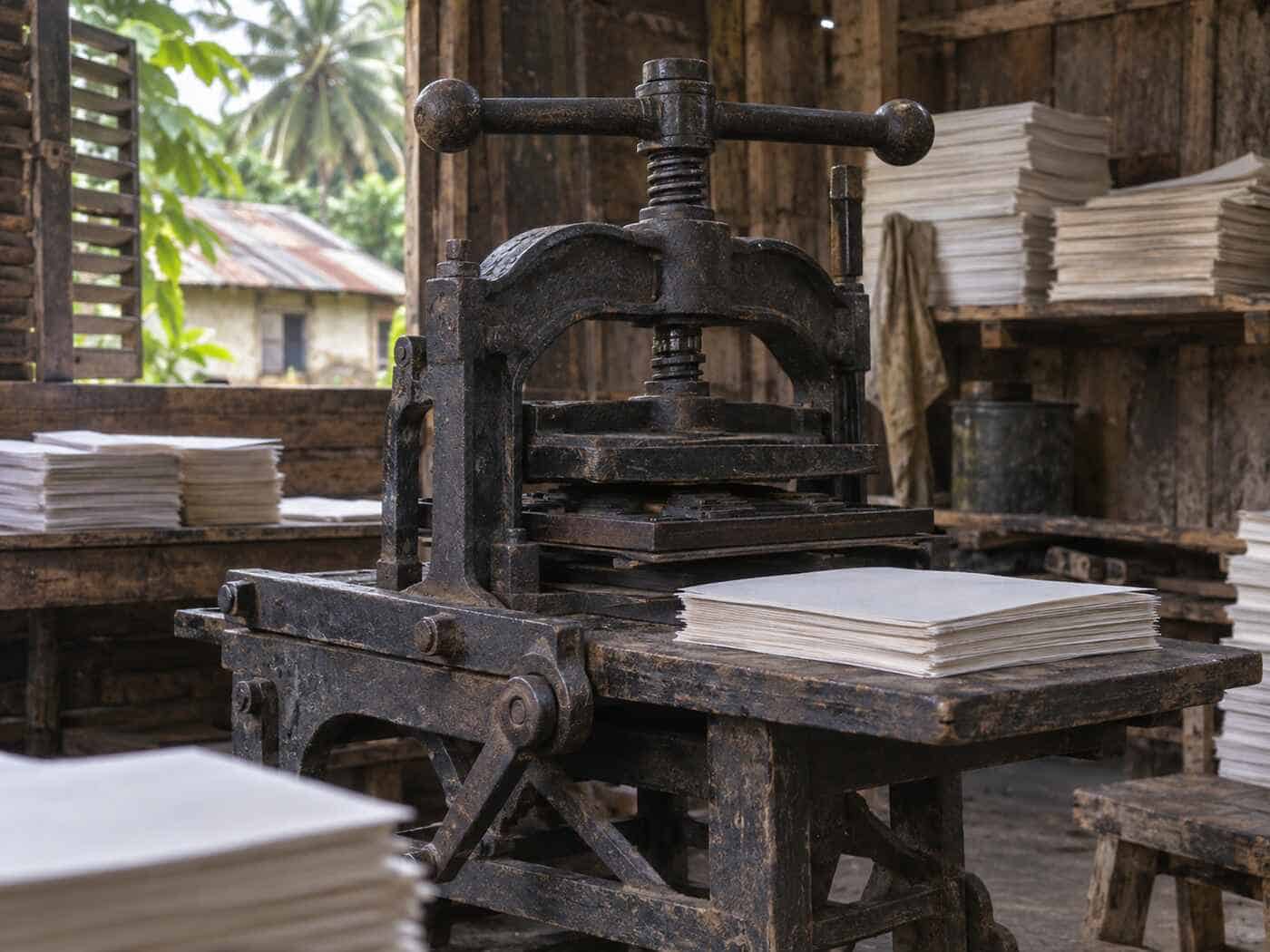
    Inked printing plates and rollers on a workbench in a small print shop
    Under the old law, printers and vendors could be jailed too. Illustration.

    Cases against journalists

    The law was not theoretical. The Wikipedia overview of media in Sierra Leone records that Paul Kamara, editor of For di People, was imprisoned for 14 months in 2004 and 2005 for seditious libel. In 2005 Harry Yansaneh, the paper’s acting editor, died of kidney failure from injuries sustained in an attack allegedly ordered by a ruling-party deputy. The same overview notes that the law was “sometimes threatened against media houses that displeased the government,” even when no charge followed.

    Other journalists were detained for shorter periods; Awoko’s founder describes the pattern in our press history, and the war-era context is covered in our history of Freetown. President Ahmad Tejan Kabbah committed in 2006 to reforming press laws, but the criminal libel provisions survived his government and the next.
    An official government gazette page lying on a desk beside a fountain pen
    The amending act appeared in the Gazette in August 2020. Illustration.

    The campaign for repeal

    Many institutions recommended repeal over the years. According to the Media Foundation for West Africa statement published by IFEX:

    • The Truth and Reconciliation Commission’s 2004 report, written after the civil war, strongly recommended removing the criminal libel law.
    • The Human Rights Commission of Sierra Leone recommended it in its annual reports.
    • The Constitutional Review Committee recommended it.
    • Section 25 of the 1991 Constitution already guaranteed freedom of expression and of the press, and Sierra Leone is party to the International Covenant on Civil and Political Rights.

    SLAJ led the campaign within the profession. MFWA names Umaru Fofana, a former SLAJ president, as one of its key champions. On the day of the repeal he thanked SLAJ, civil society, the president, the information minister, Parliament and all four parties in the House, and said he wished the late journalist Richie Olu Gordon had lived to see it.

    How was the criminal libel law repealed?

    Repeal was a manifesto commitment of President Julius Maada Bio’s government, elected in 2018. The legal instrument is the Public Order (Amendment) Act, 2020, Act No. 4 of 2020. Its section 1 repeals Part V, “Defamatory and Seditious Libel,” in full. Section 2 renumbers the remaining parts on public emergencies and police powers.

    The sources give different dates for the steps, and we set them out rather than pick one:

    StepDateSource
    Bill passed by Parliament16 July 2020Printed act
    Parliament approves repeal and the IMC Act 2020, unanimously23 July 2020MFWA via IFEX
    Act signed by the President14 August 2020Printed act
    Published in Gazette Extraordinary No. 5218 August 2020Printed act
    Formal assent ceremony at State House28 October 2020MFWA via IFEX

    The printed act is the primary legal record for its own passage and signature. The October event is described by MFWA as the official assent marked by a programme at State House in Freetown.
    A cluster of press microphones on a table in front of an empty chair
    Journalists’ groups campaigned for repeal for decades. Illustration.

    What people said

    At State House, President Bio said the law had been part of a regime that “criminalised journalism for more than half a century,” that successive governments had failed to abolish it and abused it, and that his government had “made history.” SLAJ president Ahmed Sahid Nasralla praised the president’s courage, noting that the repeal might expose him to insults and abuse. The British High Commissioner, Simon Mustard, called it a day to celebrate and argued that independent media encourages investment and public participation, MFWA reported.

    MFWA itself welcomed the change and urged Sierra Leone’s media to “guard its newly gained freedom” through greater professionalism.

    A newsroom at night with a single lit desk and a laptop open
    Civil defamation and media regulation still apply. Illustration.

    What still applies after the repeal

    The repeal removed criminal prosecution for libel and sedition. It did not remove all limits on what the press may publish:

    • Civil defamation. A person who believes they have been defamed can still sue for damages in the civil courts. The difference is that the remedy is money and correction, not prison.
    • Media regulation. The Independent Media Commission, first created in 2000, regulates the media, and Parliament passed a new IMC Act in 2020 alongside the repeal. Lewis described the commission’s original purpose as giving complainants a quick route to resolve disputes before going to court.
    • Other laws. The rest of the Public Order Act, covering public emergencies and police powers, remains in force under its new numbering.

    Anyone facing a real complaint should take legal advice from a Sierra Leonean lawyer; this guide only summarises public sources.

    Key takeaways

    • Sierra Leone’s criminal libel law was Part V of the Public Order Act 1965, covering defamatory and seditious libel.
    • Under it, truth was not a defence, and owners, printers and vendors could also be jailed.
    • The Public Order (Amendment) Act 2020 repealed Part V; Parliament passed it in July 2020.
    • The TRC, the Human Rights Commission and SLAJ had all called for repeal for years.
    • Civil defamation and regulation by the Independent Media Commission still apply.

    Common questions

    Is libel still a crime in Sierra Leone?

    No. Criminal defamatory and seditious libel were offences under Part V of the Public Order Act 1965, and that part was repealed by the Public Order (Amendment) Act 2020. A person who feels defamed can still bring a civil claim for damages.

    When did Sierra Leone repeal the criminal libel law?

    In 2020. The printed act records passage by Parliament on 16 July and the President’s signature on 14 August 2020; MFWA reports unanimous parliamentary approval on 23 July and a formal assent ceremony at State House on 28 October 2020.

    Who campaigned to repeal the criminal libel law?

    The Sierra Leone Association of Journalists led the campaign, with former president Umaru Fofana among its main champions. The Truth and Reconciliation Commission, the Human Rights Commission and the Constitutional Review Committee all recommended repeal, and regional groups such as MFWA supported it.

    Which journalists were jailed under the law?

    The best-documented case is Paul Kamara, editor of For di People, imprisoned for 14 months in 2004–05 for seditious libel. Editors such as Kelvin Lewis described frequent arrests and short detentions of journalists who criticised officials.

    How we put this together: the legal text and dates come from the printed Public Order (Amendment) Act 2020 on the Parliament of Sierra Leone website; the campaign and reactions from the MFWA statement on IFEX; the law’s effect from the 2016 View from Salone interview with Kelvin Lewis; the cases from the Wikipedia overview of media in Sierra Leone. Where dates differ we show both.

    Sources

  • Newspapers in Sierra Leone: a history from 1800 to today

    Newspapers in Sierra Leone: a history from 1800 to today

    In short: newspapers in Sierra Leone date back to 1800, when Freetown’s first working press printed the Sierra Leone Advertiser and the Royal Gazette. Freetown became a hub of African journalism in the 1860s. The press survived colonial rule, one-party government, a civil war from 1991 to 2002 and a criminal libel law that Parliament finally repealed in 2020. Today independent dailies such as Awoko sit alongside radio, the country’s most trusted medium.

    Sierra Leone has one of the oldest newspaper traditions in Africa. Its capital was printing papers before most of the continent’s cities had a press, and its journalists have argued with governments about what they may print for more than two centuries. This guide follows the Sierra Leone press from the first Freetown printing press to the independent dailies and phone screens of today. Every fact links to a source, and all sources are listed at the end.

    The first presses in Freetown

    The story starts badly. According to the Wikipedia overview of media in Sierra Leone, the first modern printing press in Africa arrived in Freetown in 1794, and a French raiding party destroyed it before it could be used. That raid was the same French attack that pillaged the young settlement, as our history of Freetown explains.

    A second press began working in 1800. It printed the Sierra Leone Advertiser and the Royal Gazette, the first newspapers in Sierra Leone. The combined Royal Gazette and Sierra Leone Advertiser ran from 1817 to 1827. These were official and commercial papers, carrying notices, shipping news and colony business, but they established printing as part of Freetown life.

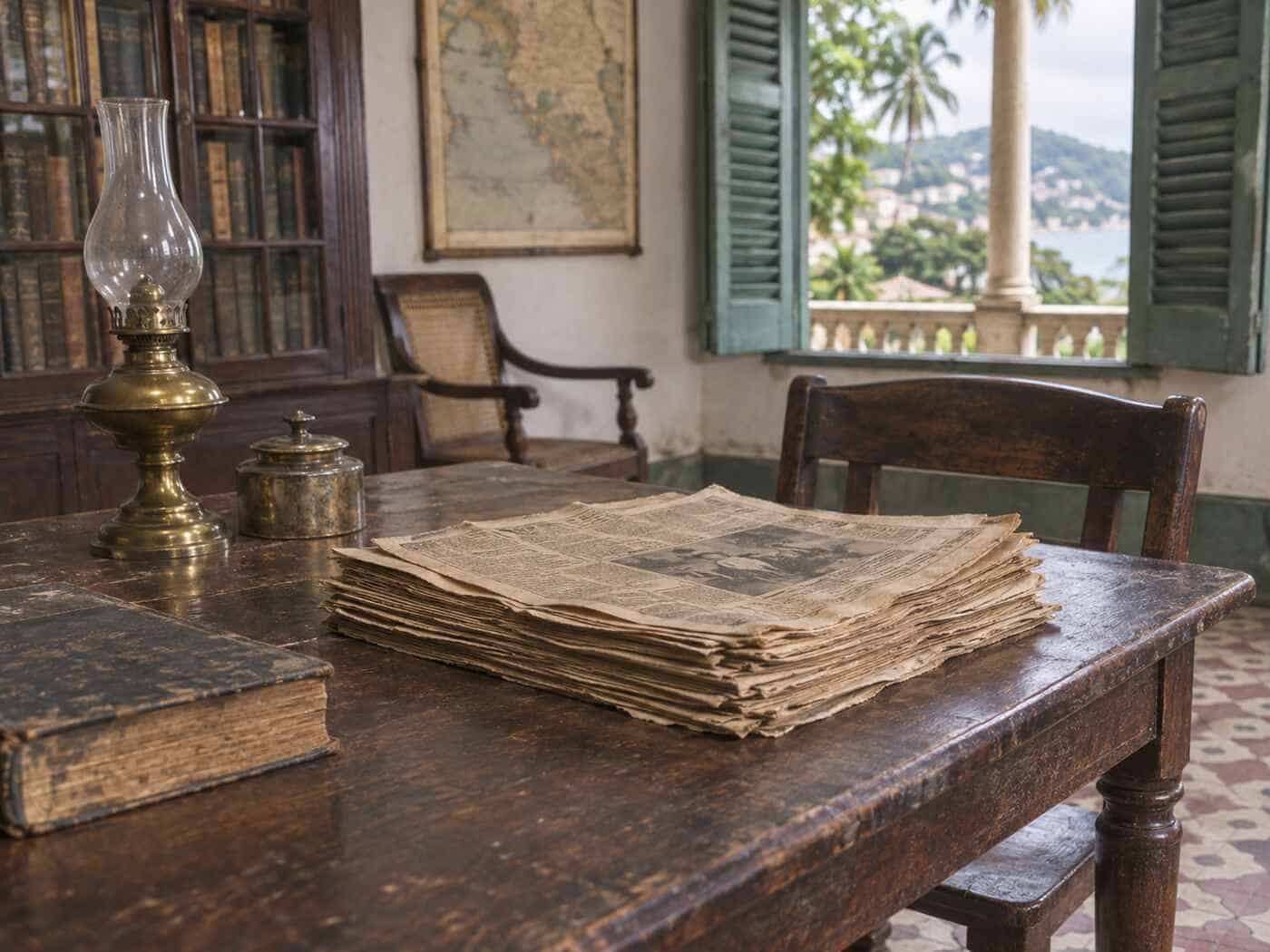
    An old wooden reading table with a stack of yellowed newspapers in a colonial-era room
    Freetown’s 19th-century papers were read and argued over in homes and reading rooms. Illustration.

    The 1850s boom and a hub of African journalism

    The real growth came in the middle of the 19th century. In the 1850s, newspaper professionals from around the world settled in Sierra Leone. The West Indian William Drake set up the New Era. In 1855, F. A. Belgrave founded the African Interpreter and Advocate and Charles Bannerman founded the Sierra Leone Weekly. By the 1860s, Sierra Leone had become a hub of African journalism, employing newspaper people from across the continent.

    These papers served the Krio community, traders, missionaries and officials, and they gave educated Freetown residents a place to argue about colonial policy, trade and schooling. The boom did not last. By the end of the 19th century, the industry had declined, because sales, the papers’ main source of income, were too low to support so many titles.

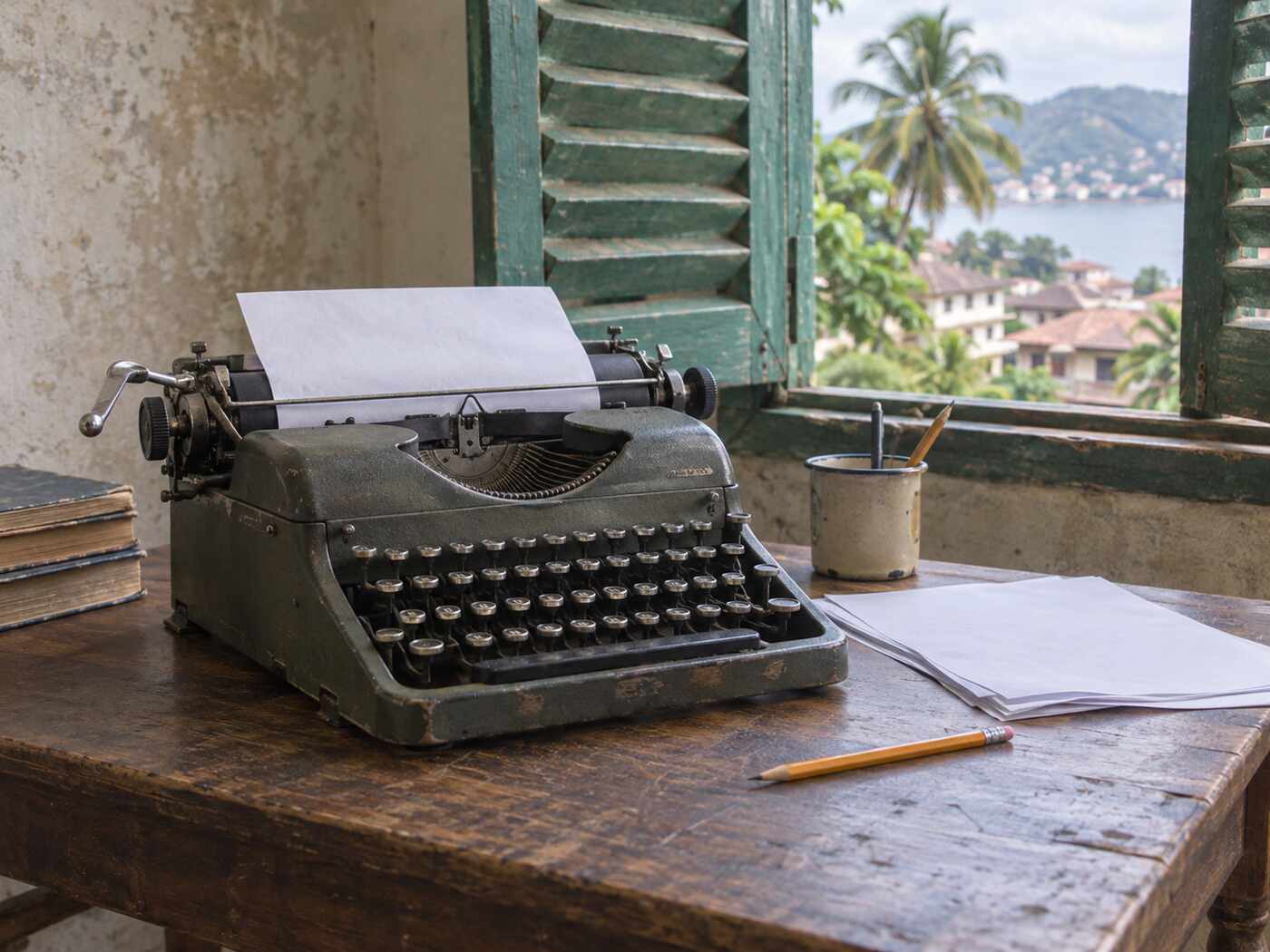
    An old manual typewriter on a wooden desk beside a shuttered window
    Typewriters and hand presses served the papers of the 20th century. Illustration.

    Colonial politics and the Daily Mail

    The 20th century brought political papers. In 1939, Isaac Theophilus Akuna Wallace Johnson started the African Standard as the newspaper of the Sierra Leone branch of the West African Youth League, an anti-colonial movement. The same year saw the launch of the Daily Mail, which became one of the country’s longest-running and leading papers.

    Broadcasting began in the same era. In 1934 the Sierra Leone Broadcasting Service was formed from the Freetown Rediffusion Service, the earliest English-language radio service in West Africa. Television followed in 1963, and coverage reached all districts in 1978, when the service was upgraded to colour.

    Independence, the libel law and one-party rule

    Sierra Leone became independent in 1961. Four years later, the Public Order Act of 1965 created criminal offences of seditious and defamatory libel. Part V of that act would hang over the Sierra Leone press for 55 years. Governments of every party used it, or threatened to, against papers that displeased them.

    Under Siaka Stevens, who led the country from 1968 to 1985, Sierra Leone became a one-party state, as the Wikipedia history of the civil war records. Critical journalism became risky. Legislation in 1980 required newspapers to register and pay fees, and by 1982 the country had only three publishers.

    A small battery radio on a market stall table beside fruit in warm afternoon light
    Radio reaches far more Sierra Leoneans than print. Illustration.

    How did the civil war affect the Sierra Leone press?

    The war that began in 1991 made reporting dangerous and publishing fragile. Between 1991 and 2007, more than 40 newspapers ceased publication. In 1996 the journalist Mohamed Bangura and others were abducted and held before being released. Journalists who went to the front took real risks.

    Kelvin Lewis, who later founded Awoko, described those years in a 2016 interview with View from Salone. He reported for Voice of America, Radio France International and Deutsche Welle, and said he and other reporters went to the war front to get stories first-hand. Local papers often printed those stories only after hearing them on the radio. Wanting to publish his own reporting first was what pushed him to start a newspaper.

    The war also produced the country’s first independent media regulator. The Independent Media Commission was created in 2000 to regulate the press and broadcasters. Lewis explained that the idea was to give people a quick place to bring complaints, so that fewer journalists ended up in court.

    A cluttered newsroom desk with a laptop, notebooks and a desk fan in a small office
    Independent dailies are produced by small newsrooms. Illustration.

    Awoko and the independent dailies

    Lewis could not afford to start a paper alone. He brought in two friends, David Tam Baryoh, who went on to own Citizen Radio, and Joseph Rahall, who moved into the NGO sector and runs Green Scenery. Awoko was independent from the start. The Sierra Leone Web directory of newspapers lists Awoko as owned and edited by Kelvin Lewis, online in 2003–04 and again from January 2007, with an app as well.

    Awoko was not alone. The same directory lists Concord Times and Global Times in Freetown, Standard Times edited by Philip Neville and online since May 2006, and Politico, alongside diaspora titles such as Cocorioko, published from New Jersey since 2002, and The Patriotic Vanguard in Canada. A 2007 survey reported in the Wikipedia overview named Awoko Times, Concord Times, For di People, Standard, Democrat and Independent Observer as the most popular newspapers, in that order.

    The paper you may be looking for is still published by its own team at awokonewspaper.sl. This site, Salone Reader, is an independent guide and has no connection with it; see our About page.

    Sierra Leone press timeline

    YearEvent
    1794First press arrives in Freetown; destroyed by French raiders
    1800Sierra Leone Advertiser and Royal Gazette begin
    1855African Interpreter and Advocate and Sierra Leone Weekly founded
    1934Sierra Leone Broadcasting Service formed
    1939African Standard and Daily Mail launched
    1965Public Order Act creates criminal libel offences
    1991–2007More than 40 newspapers close
    2000Independent Media Commission created
    2007Awoko’s current website goes online
    2020Parliament repeals the criminal libel provisions
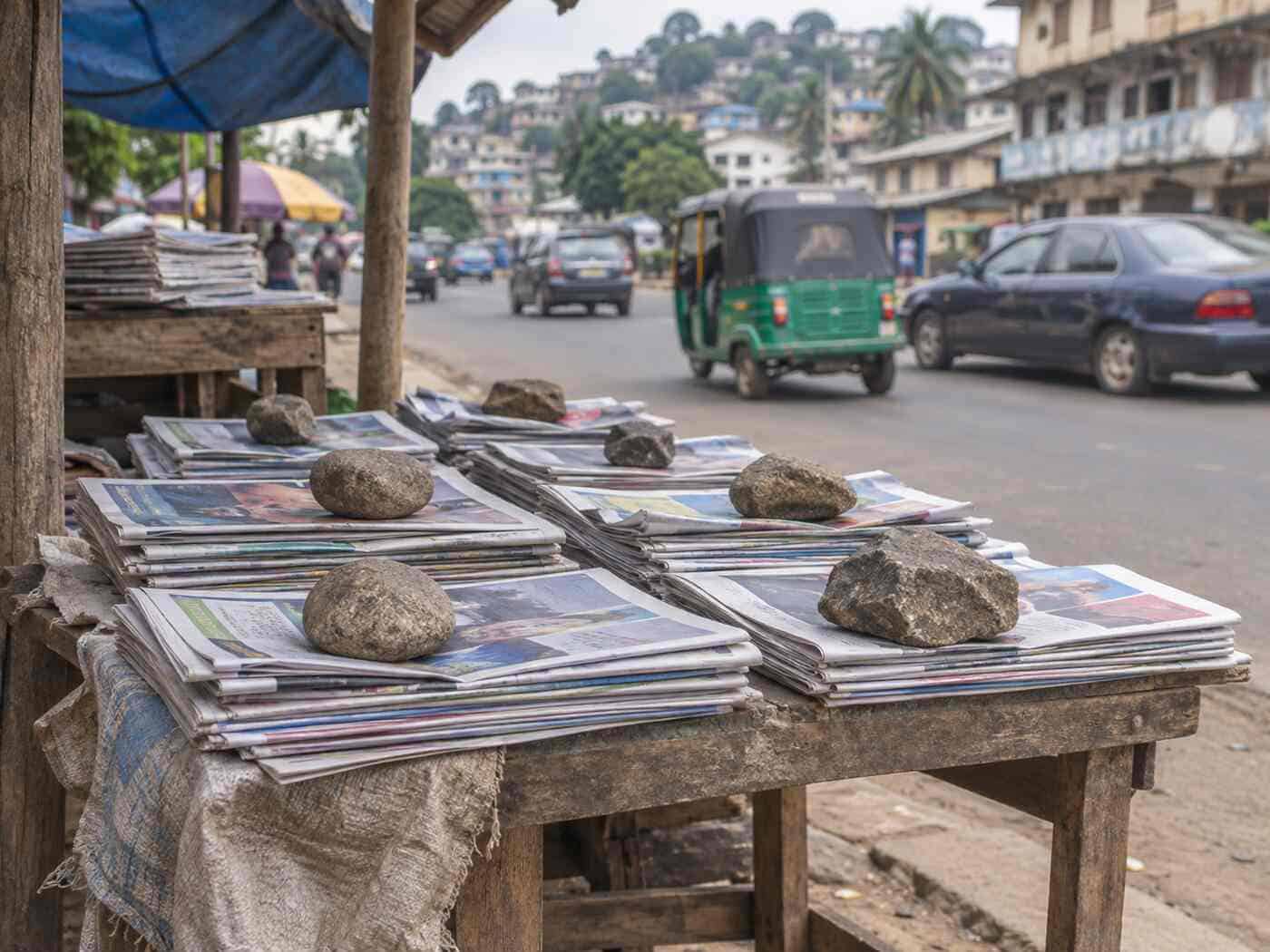
    A roadside newspaper stand with folded papers held down by stones on a busy street
    Street vendors still sell the morning papers in Freetown. Illustration.

    Press freedom and the 2020 repeal

    The libel law shaped how journalists worked long after the war ended. In 2004 and 2005, Paul Kamara, editor of For di People, was jailed for 14 months for seditious libel. In 2005 Harry Yansaneh, the paper’s acting editor, died of kidney failure after an attack. Lewis told View from Salone that the law hung over journalists “like a sword of Damocles”: truth was not a defence, and owners, printers and even vendors could be jailed for what a reporter wrote, which scared investors away from the press.

    Reporters Without Borders’ rankings show the swings. Sierra Leone was 121st in 2007 and 61st in 2013. The decisive change came in 2020. On 23 July Parliament unanimously repealed the criminal libel and sedition provisions, and President Julius Maada Bio signed the change on 28 October, according to a Media Foundation for West Africa statement published by IFEX. Our guide to the criminal libel repeal explains what changed.

    A hand holding a mobile phone showing a blurred news page, with a city street behind
    Mobile internet from 2008 changed how news is read. Illustration.

    Radio, phones and the media today

    Print has never reached most Sierra Leoneans. A 2007 BBC World Service Trust and Search for Common Ground survey found that 85 per cent of the population had access to radio and 72 per cent listened every day; radio was also the most trusted medium. In 2007 the country had 15 daily newspapers, mostly read in Freetown, and by 2010 there were 58 registered titles. Wireless internet and 3G phones arrived from 2008, and online reading grew fast.

    The State of the Media Report from the Media Reform Coordinating Group gives detailed figures on outlets, ownership and audiences for anyone researching the sector in depth. The Sierra Leone Web directory lists Radio Democracy 98.1, AYV and the national broadcaster SLBC among the main stations.

    Key takeaways

    • Newspapers in Sierra Leone began in 1800, after the first press of 1794 was destroyed by French raiders.
    • Freetown was a hub of African journalism by the 1860s.
    • The 1965 criminal libel law was used against the Sierra Leone press for 55 years until its repeal in 2020.
    • Independent dailies such as Awoko, founded by Kelvin Lewis, grew out of war-time reporting.
    • Radio remains the country’s most widely used and most trusted medium.

    Common questions

    What was the first newspaper in Sierra Leone?

    The Sierra Leone Advertiser and the Royal Gazette, both printed from 1800 on Freetown’s first working press. An earlier press, which arrived in 1794, was destroyed by French raiders before it printed anything. The combined Royal Gazette and Sierra Leone Advertiser ran from 1817 to 1827.

    Who founded Awoko newspaper?

    Kelvin Lewis, a former correspondent for international radio stations and later president of the Sierra Leone Association of Journalists. In a 2016 interview he said he started the paper with two friends, David Tam Baryoh and Joseph Rahall, and that it was independent from the beginning.

    Is Salone Reader the Awoko newspaper?

    No. Salone Reader is an independent guide to Sierra Leone’s history, media and public life. Awoko Newspaper is published by its own team at awokonewspaper.sl. We have no connection with the paper or its staff.

    Is there press freedom in Sierra Leone?

    Sierra Leone’s 1991 Constitution guarantees freedom of expression and of the press. The criminal libel and sedition provisions of the 1965 Public Order Act were repealed in 2020, removing the main legal threat to journalists, although civil defamation and media regulation still apply.

    Which is the most popular news medium in Sierra Leone?

    Radio. A 2007 BBC World Service Trust survey found 85 per cent of people had access to radio and 72 per cent listened daily, and rated it the most trusted medium. Newspapers are read mainly in Freetown.

    How we put this together: the history draws on the Wikipedia overview of media in Sierra Leone and its history of the civil war; Awoko’s founding comes from the 2016 View from Salone interview with Kelvin Lewis and the Sierra Leone Web directory; the 2020 repeal comes from the MFWA statement on IFEX. Figures are as reported in those sources.

    Sources