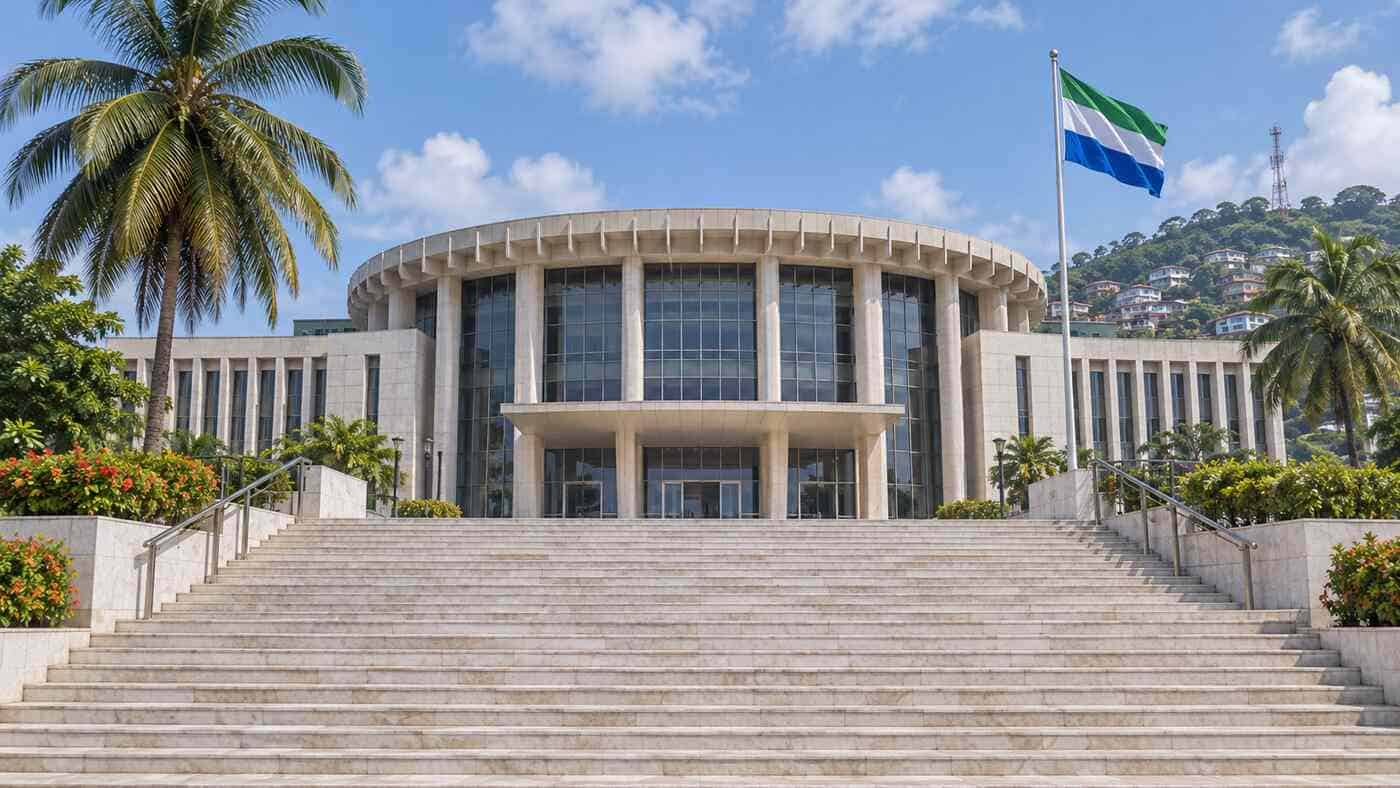
In short: Sierra Leone’s criminal libel law was Part V of the Public Order Act 1965, which made defamatory and seditious libel crimes punishable by prison. Parliament repealed it in July 2020 through the Public Order (Amendment) Act 2020, and the change was formally celebrated at State House in October 2020. Journalists can no longer be prosecuted for criminal libel, but civil defamation claims and media regulation by the Independent Media Commission still apply.
For 55 years, a Sierra Leonean journalist could be jailed for publishing something true. That was the effect of the country’s criminal libel law, as editors who lived under it described it. The law was used by governments of different parties, and its repeal in 2020 was the result of a campaign that ran for decades. This guide explains what the law said, how it was used, how it was repealed, and what rules apply to the press now. It is not legal advice. Sources are listed at the end.
What was Sierra Leone’s criminal libel law?
The law sat in Part V of the Public Order Act, 1965 (Act No. 46 of 1965), headed “Defamatory and Seditious Libel.” It created criminal offences for publishing defamatory statements and for seditious libel, broadly, publications held to stir up hatred or contempt of the government. Because these were crimes, not civil wrongs, the state could arrest, prosecute and imprison journalists, rather than leaving an offended person to sue for damages.
The law was passed four years after independence, as our history of newspapers in Sierra Leone describes. It outlived the one-party state, the civil war and several changes of government.

How the law worked in practice
Kelvin Lewis, editor of Awoko and then president of the Sierra Leone Association of Journalists (SLAJ), explained the law’s effect in a 2016 interview with View from Salone. In his account:
- Truth could be inquired into, but it was not a defence. A journalist could be jailed even if the story was accurate.
- Journalists who criticised officials could be arrested and spend days in jail.
- Owners, printers and even newspaper vendors could be held responsible and jailed for what a reporter wrote.
- That risk discouraged people with money from investing in the press, which kept media houses poor and pay low.
- The law “cowered” journalists into limiting what they reported, and hung over them “like a sword of Damocles.”
Lewis said some people left journalism because of it, and that Awoko kept publishing regardless.
Cases against journalists
The law was not theoretical. The Wikipedia overview of media in Sierra Leone records that Paul Kamara, editor of For di People, was imprisoned for 14 months in 2004 and 2005 for seditious libel. In 2005 Harry Yansaneh, the paper’s acting editor, died of kidney failure from injuries sustained in an attack allegedly ordered by a ruling-party deputy. The same overview notes that the law was “sometimes threatened against media houses that displeased the government,” even when no charge followed.
Other journalists were detained for shorter periods; Awoko’s founder describes the pattern in our press history, and the war-era context is covered in our history of Freetown. President Ahmad Tejan Kabbah committed in 2006 to reforming press laws, but the criminal libel provisions survived his government and the next.
The campaign for repeal
Many institutions recommended repeal over the years. According to the Media Foundation for West Africa statement published by IFEX:
- The Truth and Reconciliation Commission’s 2004 report, written after the civil war, strongly recommended removing the criminal libel law.
- The Human Rights Commission of Sierra Leone recommended it in its annual reports.
- The Constitutional Review Committee recommended it.
- Section 25 of the 1991 Constitution already guaranteed freedom of expression and of the press, and Sierra Leone is party to the International Covenant on Civil and Political Rights.
SLAJ led the campaign within the profession. MFWA names Umaru Fofana, a former SLAJ president, as one of its key champions. On the day of the repeal he thanked SLAJ, civil society, the president, the information minister, Parliament and all four parties in the House, and said he wished the late journalist Richie Olu Gordon had lived to see it.
How was the criminal libel law repealed?
Repeal was a manifesto commitment of President Julius Maada Bio’s government, elected in 2018. The legal instrument is the Public Order (Amendment) Act, 2020, Act No. 4 of 2020. Its section 1 repeals Part V, “Defamatory and Seditious Libel,” in full. Section 2 renumbers the remaining parts on public emergencies and police powers.
The sources give different dates for the steps, and we set them out rather than pick one:
| Step | Date | Source |
|---|---|---|
| Bill passed by Parliament | 16 July 2020 | Printed act |
| Parliament approves repeal and the IMC Act 2020, unanimously | 23 July 2020 | MFWA via IFEX |
| Act signed by the President | 14 August 2020 | Printed act |
| Published in Gazette Extraordinary No. 52 | 18 August 2020 | Printed act |
| Formal assent ceremony at State House | 28 October 2020 | MFWA via IFEX |
The printed act is the primary legal record for its own passage and signature. The October event is described by MFWA as the official assent marked by a programme at State House in Freetown.
What people said
At State House, President Bio said the law had been part of a regime that “criminalised journalism for more than half a century,” that successive governments had failed to abolish it and abused it, and that his government had “made history.” SLAJ president Ahmed Sahid Nasralla praised the president’s courage, noting that the repeal might expose him to insults and abuse. The British High Commissioner, Simon Mustard, called it a day to celebrate and argued that independent media encourages investment and public participation, MFWA reported.
MFWA itself welcomed the change and urged Sierra Leone’s media to “guard its newly gained freedom” through greater professionalism.

What still applies after the repeal
The repeal removed criminal prosecution for libel and sedition. It did not remove all limits on what the press may publish:
- Civil defamation. A person who believes they have been defamed can still sue for damages in the civil courts. The difference is that the remedy is money and correction, not prison.
- Media regulation. The Independent Media Commission, first created in 2000, regulates the media, and Parliament passed a new IMC Act in 2020 alongside the repeal. Lewis described the commission’s original purpose as giving complainants a quick route to resolve disputes before going to court.
- Other laws. The rest of the Public Order Act, covering public emergencies and police powers, remains in force under its new numbering.
Anyone facing a real complaint should take legal advice from a Sierra Leonean lawyer; this guide only summarises public sources.
Key takeaways
- Sierra Leone’s criminal libel law was Part V of the Public Order Act 1965, covering defamatory and seditious libel.
- Under it, truth was not a defence, and owners, printers and vendors could also be jailed.
- The Public Order (Amendment) Act 2020 repealed Part V; Parliament passed it in July 2020.
- The TRC, the Human Rights Commission and SLAJ had all called for repeal for years.
- Civil defamation and regulation by the Independent Media Commission still apply.
Common questions
Is libel still a crime in Sierra Leone?
No. Criminal defamatory and seditious libel were offences under Part V of the Public Order Act 1965, and that part was repealed by the Public Order (Amendment) Act 2020. A person who feels defamed can still bring a civil claim for damages.
When did Sierra Leone repeal the criminal libel law?
In 2020. The printed act records passage by Parliament on 16 July and the President’s signature on 14 August 2020; MFWA reports unanimous parliamentary approval on 23 July and a formal assent ceremony at State House on 28 October 2020.
Who campaigned to repeal the criminal libel law?
The Sierra Leone Association of Journalists led the campaign, with former president Umaru Fofana among its main champions. The Truth and Reconciliation Commission, the Human Rights Commission and the Constitutional Review Committee all recommended repeal, and regional groups such as MFWA supported it.
Which journalists were jailed under the law?
The best-documented case is Paul Kamara, editor of For di People, imprisoned for 14 months in 2004–05 for seditious libel. Editors such as Kelvin Lewis described frequent arrests and short detentions of journalists who criticised officials.
How we put this together: the legal text and dates come from the printed Public Order (Amendment) Act 2020 on the Parliament of Sierra Leone website; the campaign and reactions from the MFWA statement on IFEX; the law’s effect from the 2016 View from Salone interview with Kelvin Lewis; the cases from the Wikipedia overview of media in Sierra Leone. Where dates differ we show both.
Sources
- Parliament of Sierra Leone: Public Order (Amendment) Act, 2020
- IFEX / MFWA: Sierra Leone repeals criminal libel law, 2020
- View from Salone: Q&A with Kelvin Lewis, 2016
- Wikipedia: Media of Sierra Leone
- Wikipedia: Truth and Reconciliation Commission (Sierra Leone)
- Media Reform Coordinating Group: State of the Media Report